-
CYCLOPS Bollard for Residential Applications
-
DarkSky Certification
-
Mini VAREE Underwater Light
-
Unilamp Welcomes CWL Lighting
-
Residential Lighting Solutions
-
Project: Ten Six Hundred, Thailand
-
ZOUK Wall Lighting for Residential Applications
-
Project: Toorak College, Australia
-
CHARISMA Bollard for Residential Lighting
-
BALIKA Visits Unilamp Factory
-
Project: SUARGA Padang Padang, Indonesia
-
ALPHA Spotlights for Residential Lighting
-
LuxBeat Lighting for Modern Residential Spaces
-
GINGGAANBAI at Baanlaesuan Fair Midyear 2026
-
BRONCO Wall Surface Light
-
Unilamp Supports Pom Mahakan Lighting
-
Low Voltage Lighting
-
ZET Architectural Inground Lighting
-
Project: Wat Tha Sung, Thailand
-
Facade Lighting Solutions
-
Webinar : Lighting the Way Forward 2026 | Facade
-
BICEPS Low-Glare Landscape Lighting
-
Premium Underwater Lighting Collection
-
Unilamp Hosts Lunch & Learn with Light.Func
-
Lighting Talk with Spatial Vibes
-
UniGreen
-
Project: The Ground Bangkok, Thailand
-
New Facade Lighting Brochure
-
Unilamp Factory Tour
-
Why Unilamp Underwater Luminaires Stand Out
-
Unilamp Welcomes Partners from Malaysia
-
Electrical Supply Corp Visits Unilamp
-
Project: Elizabeth Properties, New Zealand
-
Unilamp Webinar for New Mini CETUS
-
Mini CETUS Spotlight
-
AR+D Thesis Exhibition 2025
-
New Team Members Join Unilamp India & Middle East
-
Unilamp’s Team
-
Project Reference: Residence 15, Hyderabad, India
-
LedsC4 officially partners with Unilamp
-
Illuminates Palette of Materials Pavilion
-
Architect Expo 2026 Highlights
-
Project Reference: Central Westville, Thailand
-
Unilamp Webinar for New Mini VAREE
-
Unilamp at Architect Expo 2026
-
Micro AYERS Inground Light
-
Unilamp Joined DIALux session with PL Light
-
Unilamp Visits Nulty Lighting
-
DIALux Plugin New Update 2026
-
Polaris Lighting Visits Unilamp
-
Hiring: Senior Sales Government Projects
-
Job Opportunities
-
Quantum Implications at KU
-
Case Study: Heffron Centre, Australia
-
Joins Light + Building 2026
-
DIALux EVO Training by Unilamp at Kasetsart
-
Project Reference: Heffron Centre, Australia
-
DarkSky Compliance
-
Project Reference: City University, Hong Kong
-
New Business Development Manager at Unilamp India
-
Unilamp Supports CU Lighting Master Plan
-
The Power of Lighting Podcast - JUTI Architects
-
Q&A Night Sky Webinar 2026
-
Recap Night Sky Webinar 2026
-
THE 20 YEARS AHEAD by GingGaanBai
-
Litelab Visits Unilamp 2026
-
Lighting the Way Forward 2025 Night Sky Solutions
-
Unilamp Supports Light Arch Feb Fest 2026
-
Project: Stora Torget, Sundsvall, Sweden
-
Unilamp Supports ABAC Echoes of Memory Exhibition
-
Unilamp Lights SHMA’s Long Heal Exhibition
-
Mini ARC Outdoor Inground Light by Unilamp
-
Scholarships 2025 for Employees’ Children
-
The Power of Lighting Podcast - Zion Dzine
-
Case Study: St.Raphael Catholic Church, Thailand
-
Unilamp at Light Middle East Awards 2026
-
Project: St. Raphael Catholic Church, Thailand
-
Unilamp Appoints New SAARC Regional Manager
-
Project : National Amusement Park, Mongolia
-
Strike into Christmas with Unilamp
-
Project Reference: Shri Mata Vaishno Devi, India
-
Case Study: Bonbeach Life Saving Club, Australia
-
Case Study: Awadh Projects, India
-
HYPERION High-Performance Pole Mounted Lighting
-
The Power of Lighting Podcast – Lucent Worldwide
-
Project Reference: Avadh Utopia, Surat, India
-
University of Mindanao Visits Unilamp
-
Zion Dzine and Luxus Team Visit Unilamp
-
Project Reference: Avadh Heliconia, Vapi, India
-
Project Reference: Avadh Ayuska, Navsari, India
-
Lighting Talk with SSLD Dubai
-
Q&A Lightscapes Webinar 2025
-
Recap Lightscapes Webinar 2025
-
University of Negros Occidental-Recoletos Visits Unilamp
-
Project Reference: Residence 14, India
-
Unilamp Appoints New Regional Manager
-
Unilamp Lighting Knowledge Shared with UNO-R
-
Webinar : Lighting the Way Forward 2025 | Lightscapes
-
Unilamp Knowledge Shared with La Carlota City
-
Lucent Worldwide and Lite N Style Visit Unilamp
-
Unilamp Wraps Up Jakarta Architecture Festival 2025
-
Lighting the Way Forward in Indonesia
-
Unilamp at Baan Lae Suan Fair Living Festival 2025
-
Unilamp Joins Jakarta Architecture Festival 2025
-
Project Reference: Residence 13, India
-
Light Touch Visits Unilamp Thailand
-
Case Study Courtyard by Marriot, India
-
Infusion Lighting Visit
-
Project Reference: One Bangkok, Thailand
-
Luminaires for LED Retrofit Lamps Brochure
-
Lighting Talk with XO Lights
-
SURYA Solar Street Light
-
The Power of Lighting Podcast - Clout Edge Technologies
-
Unilamp at Baan Lae Suan Fair Mid Year 2025
-
Q&A from Webinar Lighting the Way Forward 2025
-
Webinar : Lighting the Way Forward 2025
-
Upgraded: Mini SONIC & TELESCOPE Luminaires
-
Lighting the Way Forward in Vietnam
-
Phasing Out of Products in 2025
-
Lighting Talk with Light.Func
-
Project Reference: Wan Chai, Hong Kong
-
Welcomes LITELAB & Trinity Solutions
-
Project Reference: Elio Del Nest, Thailand
-
Welcomes Clout Edge
-
Welcomes Aydinlatma Merkezi
-
Phasing Out of Products in 2024
-
Project Reference: Residence 12, Thailand
-
Project Reference: Arbour, Pattaya
-
ACQUA – No.1 in Underwater Lighting
-
Project Reference: INFORTAR Office Building, Estonia
-
UniShield16 Coating Process
-
Project Reference: Anna Ticho House, Israel
-
CYCLOPS Corten Finish
-
Project Reference: The Strand Thonglor, Thailand
-
Unilamp: Delivering Excellence
-
Project Reference: Varner HQ, Norway
-
Project Reference: Lohas Park, Hong Kong
-
Project Reference: Al Masar Park, Abu Dhabi, UAE
-
Unilamp Middle East Iftar 2025
-
Unilamp x Ginggaanbai 2025
-
Project Reference: RIU Hotel, Dubai
-
Elevating Lighting Expertise for Future Designers
-
Green Industry Certification
-
Project Reference: Bonbeach Life Saving Club, Australia
-
Unilamp Welcomes ScenoLight Atelier
-
Project Reference: Rashid Park, Abu Dhabi, UAE
-
Project Reference: Yas Bay Park, Abu Dhabi UAE
-
Unilamp Hosts FiraLux for a Special Visit
-
UniBreath
-
Unilamp’s Yacht Party 2025 Lights Up the Dubai Skyline
-
Unilamp's New Working Catalog 2025-2026
-
Project Reference: Kennedy Kakal Park, Israel
-
Bangkok Design Week 2025
-
Light Middle East Awards 2025
-
Dubai Chamber of Commerce
-
Tha-Sung Temple Walkway – Featuring EPSYLON
-
Winners of the Middle East Lighting Design Awards 2024
-
Unilamp Launches UniModification
-
Project Reference: Courtyard by Marriott Aravali Resort
-
Project Reference: GS Plaza
-
Friend of Unilamp (Testimonials)
-
Exclusive Distributors in Singapore
-
Project Reference: NGC Park of Sipalay City - Philippines
-
Project Reference: MBK Shopping Mall - Thailand
-
New product: BICEPS 4S Bollard
-
Project Reference: Gymsnasium, Estonia
-
Project reference in Oslo, Norway
-
Home and Garden Fair Midyear 2024 - Thailand
-
Unilab Testing Laboratory
-
Dialux plug-in Updated
-
Product Updated: ALESSA, NARA, NELLA, REGOR
-
Duga Sustainable City 2024 - Thailand
-
Unilamp Middle East Lighting Design Awards 2024
-
Unilamp Receives Prestigious CSR Award
-
Project Bharat Mandapam
-
New! Medium CETUS Projector
-
New! Mega BRONCO
-
DIALux Training Session for everyone...
-
Unilamp display at Light Sketch Experience Centre
-
Unilamp showcased at iDAC Mumbai 2024 at the BEPS stand
-
New! LuxBeat Underwater Linear Light
-
Celebrating 30 Years in Middle East
-
New addition! Maxi TUBE RGBW DMX
-
Project Scope Promsri
-
New! Uplight Shield Cover for CASA bollard
-
Lighting showcase at Phaya Thai Palace 101 years old
-
Unilamp joined the CNY Open House 2024
-
Unilamp sponsored for garden runway event
-
Unilamp partners with Fos Lighting Design for BKKDW2024
-
Project Marche Thonglor
-
Thanks Luxus Lighting Solutions, Slight company, Light and Beyond
-
Supported for a lighting workshop in Bangkok
-
Project Infortar Office Building
-
Thanks Stealth Ventures Corporation
-
The 7° Ultra-Narrow Beam Option
-
accessory Adjustable Aluminium Earth Spike
-
Project Botanical Garden
-
Thanks Lamar
-
PRIMUS The Innovative Pole Top Solution
-
CIC – Cite Internationale Des Chercheurs
-
Thanks Light and Shade Inc.
-
Thanks Enhance Light
-
Unilamp, a special speaker at KMUTT
-
Thanks Brilliance
-
Project Noble Curate and Noble Curve
-
Thanks Litelab
-
LuxBeat XL Ceiling Recessed, Wall Recessed
-
Project Queen Sirikit Convention Center
-
Thanks Lucent worldwide, Lite N Style from India
-
Mini PILLAR Catenary,Mini TUBE Catenary
-
Thanks Argos Arkaya Power Solutions LLP
-
Thanks Aydinlatma Merkezi
-
Tree Strap for Mini KUBIK spotlight
-
Spike for Micro ALPHA & Micro KUBIK
-
New accessory! Spike L900 for TELESCOPE
-
Thanks Directorate of civil engineering
-
Thanks Light Up Design
-
Unilamp partners with Lightcraft
-
Congratulations! Steve L. Aries
-
Thanks Studio Nimmersatt
-
THANKS District Chief Officer of Ban Sang district
-
Light Middle East | Intelligent Building
-
Project Via Riyadh, Saudi Arabia
-
Introducing Unilamp Lighting Design Centre
-
Linear Lighting Series
-
New addition! Medium ALPHA Round COB
-
Unilamp's journey in Singapore
-
Unilamp visits BioArchitek
-
Unilamp at Temca M&E Thailand 2023
-
Unilamp achieves BIS certification
-
NEW! VELA Accent light - Windowlight
-
Thanks Final Glow to visit Unilamp Showroom
-
Customized Solutions - Medium ALPHA Round ID
-
Unilamp visits DJCoalition Thailand
-
Meet Unilamp at Temca M&E Thailand 2023
-
Introducing new team member: RAVI & AFHAM
-
New! Medium SPACE RGBW
-
New! Medium CAP
-
New! NEOPLACE
-
New! BUZZ4 Ground Washer
-
Unilamp achieves SNI Certification
-
Thanks Silex to visit UNILAMP showroom
-
New product: KORNER
-
New! STICK Direct
-
Architect 2023
-
LUXBEAT
-
PRODUCT PHASE OUT LIST
-
THE UNDERWATER LUMINAIRE SERIES
-
CASA
-
Architect Expo 2022
-
NEOS
-
Mini ALPHA Square - ID
-
NEW SHARP ELLIPTICAL SERIES
-
New Product - Mini PILLAR
-
News : New colour Wooden Brown
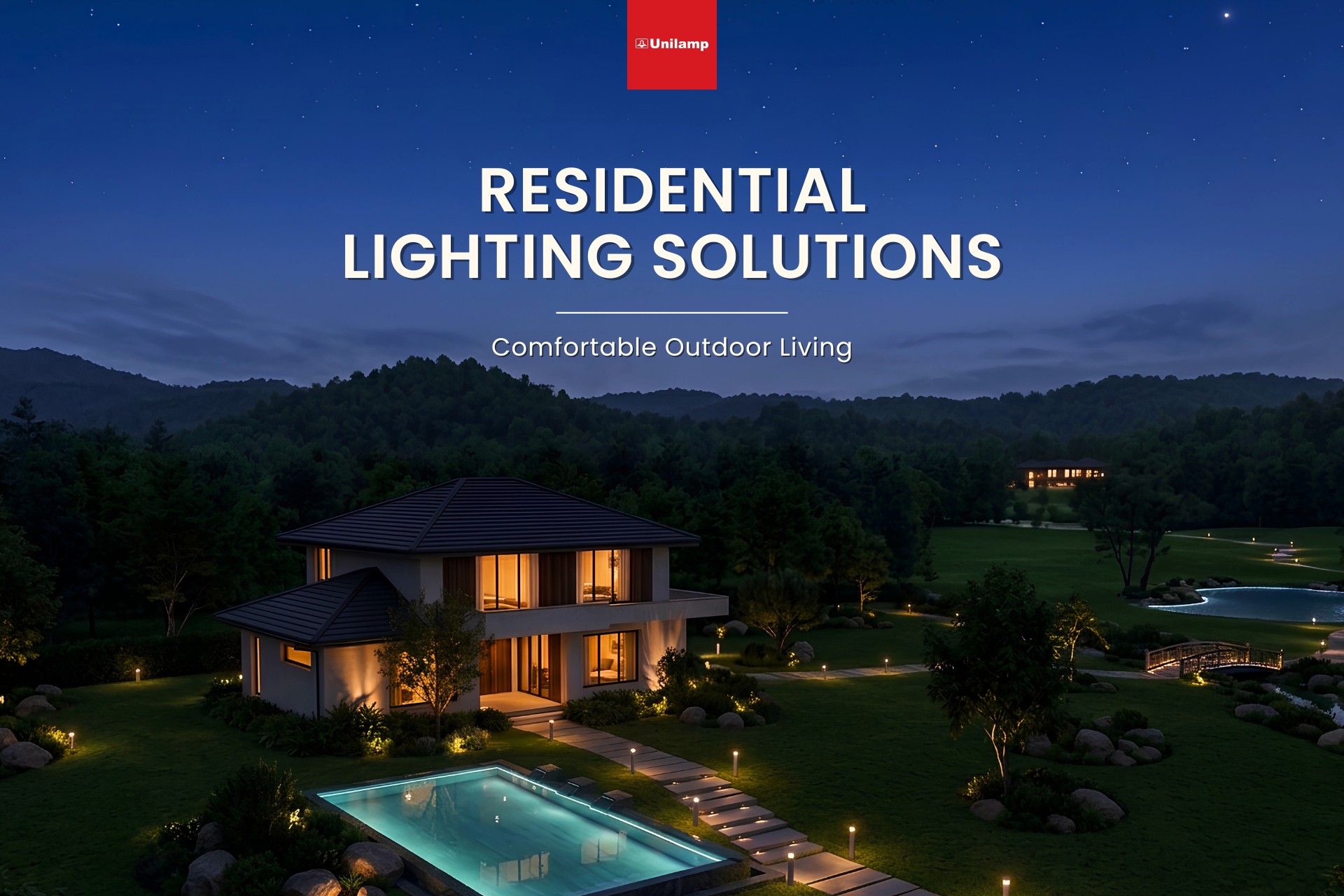
Residential Lighting Solutions
Thoughtful residential lighting solutions make a home welcoming, comfortable to navigate, and enjoyable after sunset. From the entrance and garden paths to terraces and water features, each area benefits from lighting that responds to how it is used.
The best starting point is everyday life: arriving home, walking through the garden, sharing a meal outdoors, or enjoying the view from a living room window. These moments help define where light is needed and what it should achieve.
This guide explores practical ways to plan outdoor residential lighting, with applications from Unilamp’s CHARISMA, ZOUK, ALPHA, LuxBeat, ZET, and ACQUA collections.
Plan Your Outdoor Lighting Around Everyday Activities
Before choosing fixtures, map the areas where people move, gather, and relax. Identify entrances, changes in level, seating areas, and architectural or landscape features you want to highlight.
Think about three complementary layers of light:
- General lighting establishes background illumination around entrances and outdoor living areas.
- Task lighting supports activities such as finding keys, preparing food, or navigating steps.
- Accent lighting brings attention to selected trees, textures, and architectural details.
Consider these layers together. A strongly illuminated wall may make an adjacent path appear darker, while a visible light source can become distracting from a terrace. Also review the garden from inside the home. Lighting a carefully chosen feature beyond a window can add depth to the evening view.
Create Welcoming Pathways with Bollard Lighting
Pathway lighting helps people navigate bends, intersections, and changes in surface while maintaining a comfortable atmosphere. Bollards suit garden paths and open areas without nearby walls, with placement guided by path width, planting, and light distribution to create comfortable transitions along the route. Unilamp’s CHARISMA bollard series combines an elegant form with visual comfort for residential pathways and landscaped approaches.
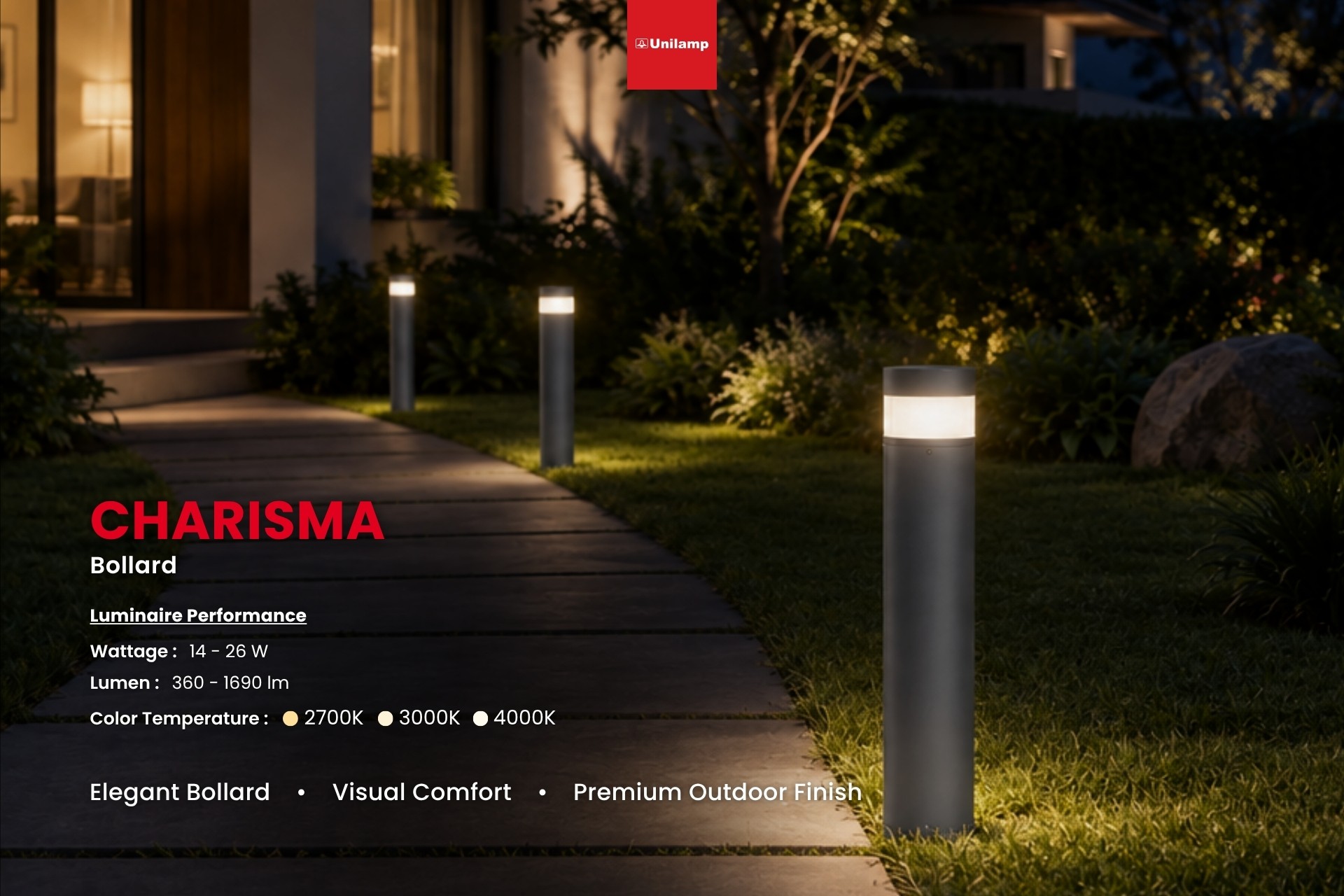
Planning tip: Review bollard positions from nearby windows and outdoor seating. Check that the fixtures illuminate the route without becoming distracting bright points in the view.
Explore CHARISMA Bollard Lights →
Integrate Light into Walls Beside Paths and Steps
Wall lighting illuminates paths and stairways without adding freestanding fixtures, helping people recognize walking surfaces and changes in level. UNILAMP’s ZOUK family offers both wall recessed and wall surface lights to suit different architectural and installation needs. Coordinate mounting height, spacing, and light distribution to achieve comfortable coverage, and test the arrangement after dark to identify distracting shadows before finalizing positions.
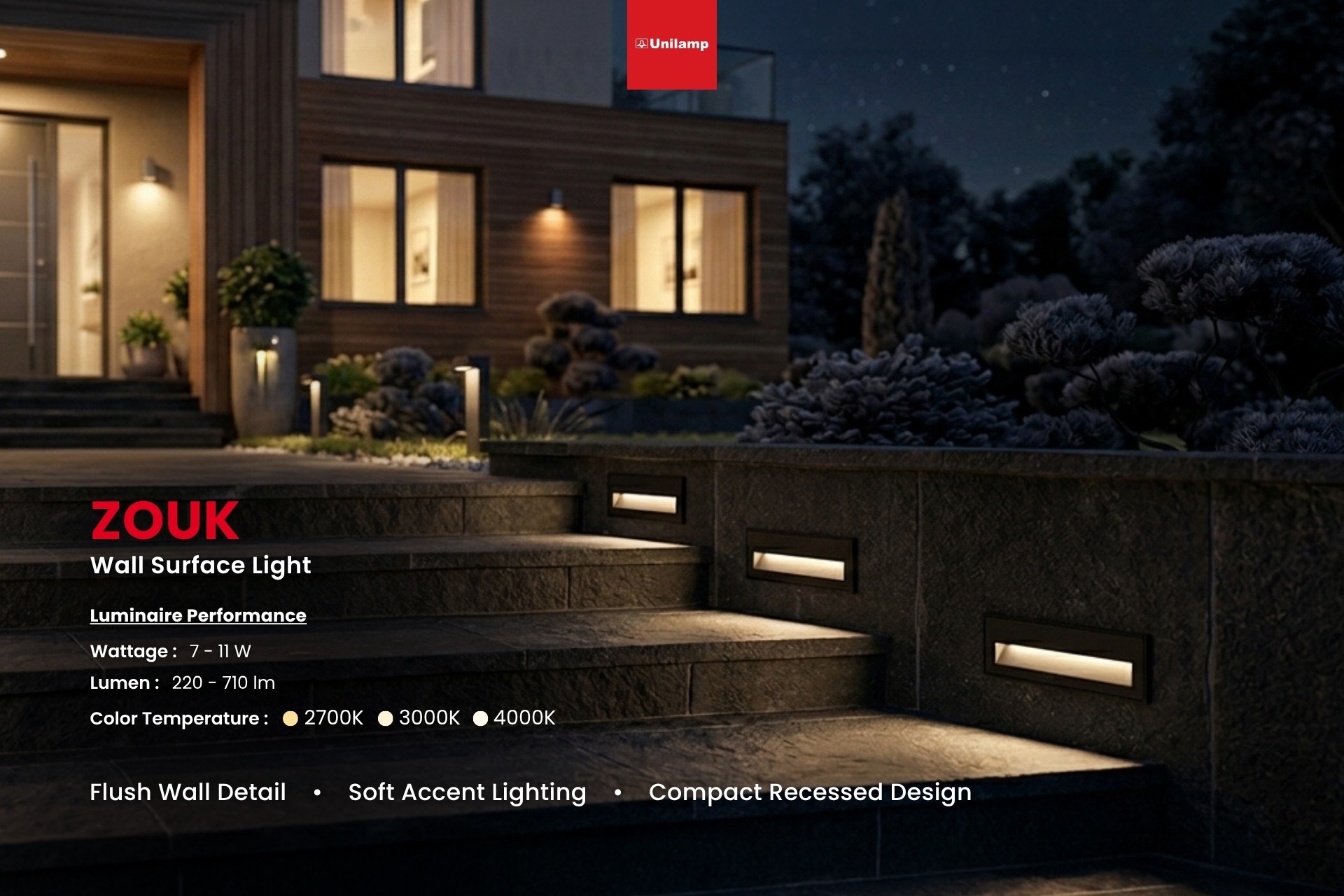
Planning tip: Coordinate wall recesses, cable routes, and maintenance access before wall finishes are completed.
Explore ZOUK Wall Recessed Lights →
Highlight Trees and Architectural Features with Spotlights
Accent lighting draws attention to features that define a home’s character, such as columns, textured walls, or distinctive trees. Match the beam angle and fixture distance to the subject’s size and shape. Unilamp’s ALPHA spotlight family offers varied beam distributions and mounting options for architectural and landscape accents, with positioning that can be reviewed as planting grows to maintain the intended effect.
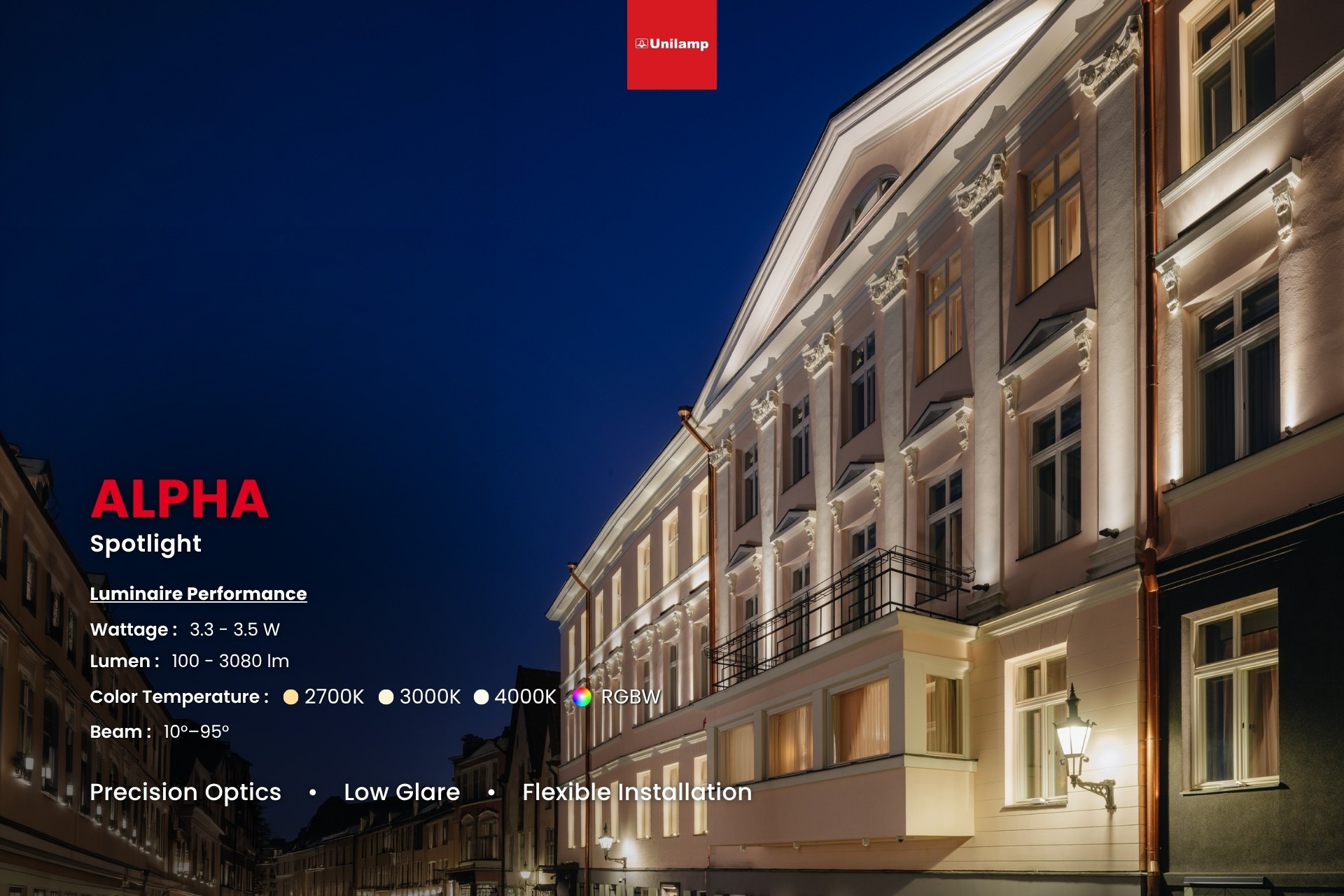
Planning tip: Aim spotlights after dark and check them from normal viewing positions. Direct light towards the intended feature and away from windows and people’s eyes.
Define Architectural Lines with Linear Lighting
Linear lighting highlights selected edges and surfaces to reinforce a home’s architectural character without making the exterior feel visually busy. Unilamp’s LuxBeat family offers compact linear lighting options for architectural, landscape, and selected underwater applications, helping create a consistent lighting approach across residential spaces. Consider corners, joints, surface reflectivity, and viewing angles when planning the installation to achieve a smooth, continuous effect.
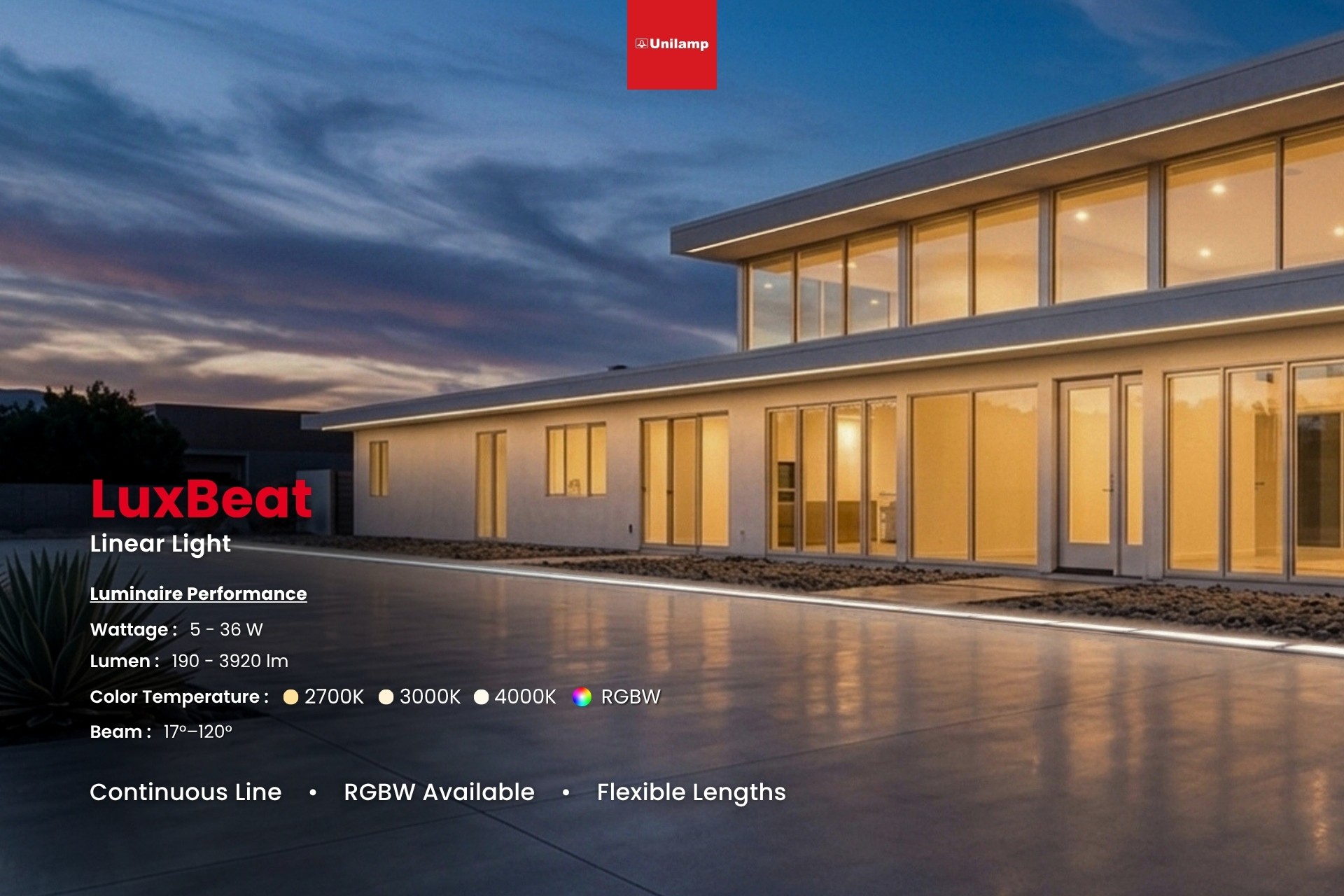
Planning tip: Test a short section against the actual material before installation. Check both the illuminated surface and the visibility of the light source from the house and terrace.
Explore LuxBeat Linear Lighting →
Use Inground Lighting for Discreet Landscape Accents
Inground lighting highlights architectural and landscape features while keeping fixtures integrated into paved or planted areas. Unilamp’s ZET family offers configurations for these applications, with optics and positioning selected to suit the subject while avoiding glare for passers-by. Plan for drainage, ground preparation, and maintenance access, and confirm the selected model’s load rating and installation requirements wherever vehicles may pass over it.
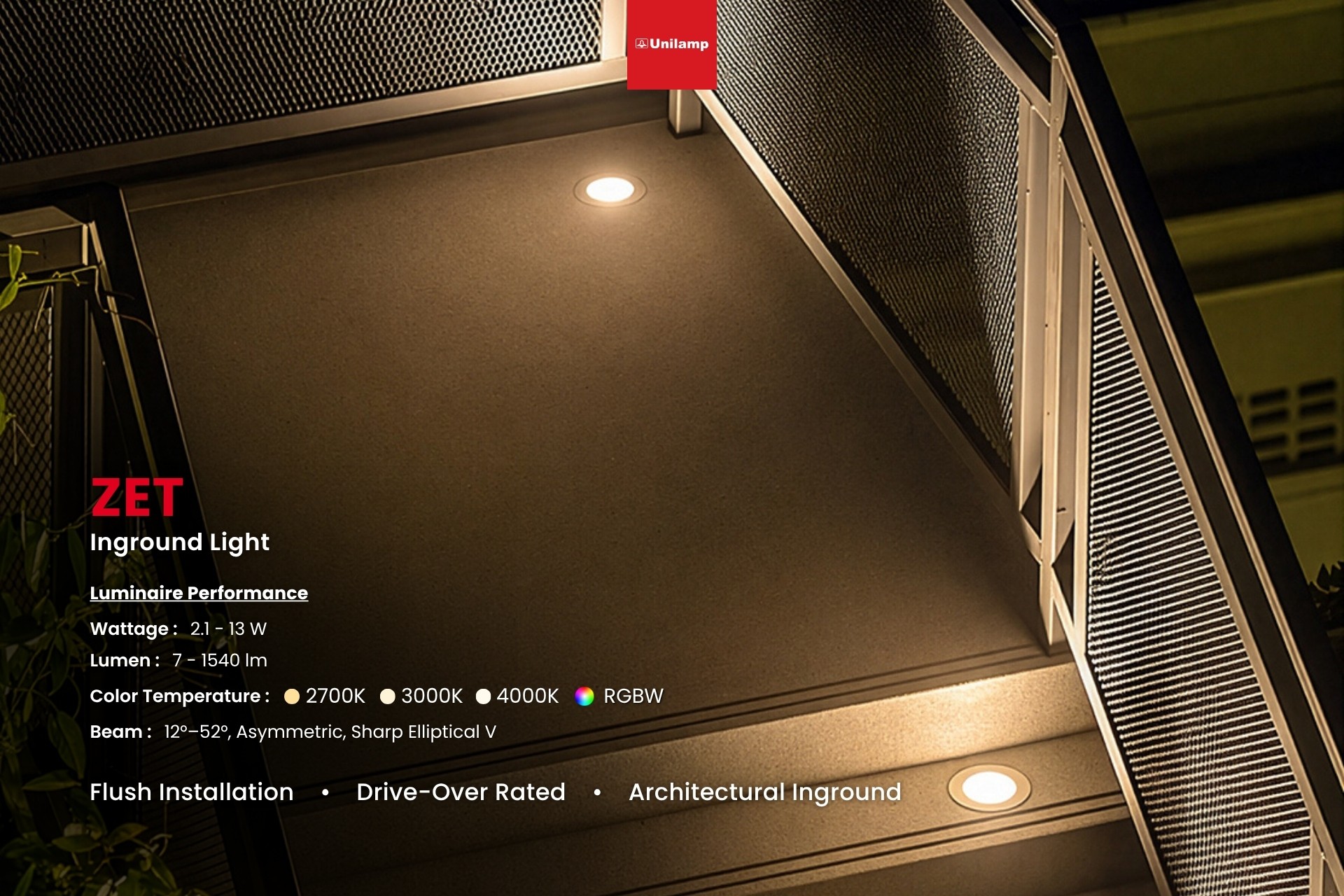
Planning tip: Plan drainage and maintenance access alongside fixture placement. These details are easier to resolve before paving and landscaping are complete.
Add Depth to Water Features with Underwater Lighting
Underwater lighting brings movement and reflection to pools, ponds, and fountains, with the effect shaped by water depth, surface finishes, and viewing direction. Unilamp’s ACQUA range offers directional lighting options to highlight these features while managing glare from terraces and living spaces. Select the configuration for the intended installation, checking permitted immersion conditions, water compatibility, and installation requirements alongside the IP rating.
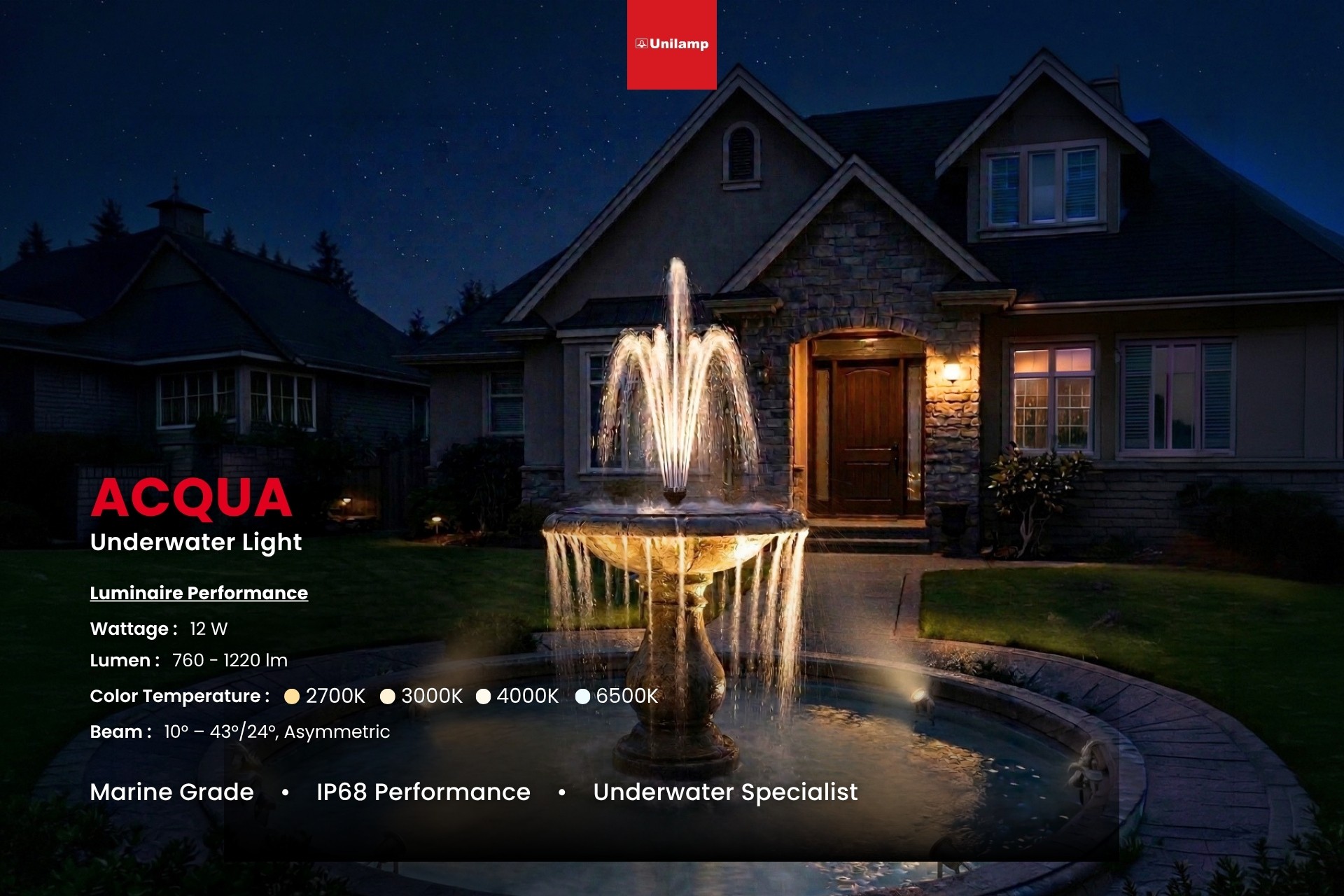
Planning tip: Coordinate fixture locations, cable routes, and service access early, particularly for pools and permanent water features.
Explore ACQUA Underwater Lights →
Choose Light Quality for a Comfortable Residential Setting
Selecting the right fixture type is one part of the process. Colour temperature, glare control, and operation also shape the experience of an outdoor space.
Coordinate Colour Temperature Across Connected Areas
Warm white options such as 2700K or 3000K can provide a starting point for a relaxed residential atmosphere. Review samples against the actual materials, as timber, stone, paint, and foliage respond differently to light.
Using a consistent colour temperature across connected spaces helps the scheme feel coherent. Confirm availability for each selected product configuration.
Consider Glare from Everyday Viewing Positions
Check the lighting from standing and seated positions, both outdoors and inside the home. A fixture that appears comfortable beside a path may be more noticeable from a lower lounge chair.
Beam selection, shielding, mounting height, and aiming should work together to keep the light comfortable within these views.
Match Lighting Controls to Daily Routines
Separate circulation lighting from decorative accents so each can operate when needed. Garden features may switch off earlier while entrance lighting remains available.
Where the selected fixtures and drivers support dimming, light levels can be adjusted for different activities. Confirm compatibility when specifying the system.
Review Your Lighting Plan Before Installation
Before finalising the design, ask:
- Are entrances, paths, and changes in level clearly visible?
- Does each illuminated feature have a purpose?
- Are light sources comfortable to view from windows and seating areas?
- Are colour temperatures coordinated?
- Have drainage, environmental exposure, and maintenance access been addressed?
- Can individual lighting areas be controlled according to when they are used?
Where possible, trial sample fixtures after dark. Small adjustments to position, beam direction, and output can make a meaningful difference to the finished result.
A considered residential lighting scheme brings architecture, landscape, and everyday activities together. Begin with the needs of each space, then use the relevant Unilamp product pages to compare configurations and develop the lighting approach that suits your home.
To explore Unilamp's residential lighting solutions or discuss the lighting requirements of your project, visit www.unilamp.co.th or contact online@unilamp.co.th
-
CYCLOPS Bollard for Residential Applications
-
DarkSky Certification
-
Mini VAREE Underwater Light
-
Unilamp Welcomes CWL Lighting
-
Residential Lighting Solutions
-
Project: Ten Six Hundred, Thailand
-
ZOUK Wall Lighting for Residential Applications
-
Project: Toorak College, Australia
-
CHARISMA Bollard for Residential Lighting
-
BALIKA Visits Unilamp Factory
-
Project: SUARGA Padang Padang, Indonesia
-
ALPHA Spotlights for Residential Lighting
-
LuxBeat Lighting for Modern Residential Spaces
-
GINGGAANBAI at Baanlaesuan Fair Midyear 2026
-
BRONCO Wall Surface Light
-
Unilamp Supports Pom Mahakan Lighting
-
Low Voltage Lighting
-
ZET Architectural Inground Lighting
-
Project: Wat Tha Sung, Thailand
-
Facade Lighting Solutions
-
Webinar : Lighting the Way Forward 2026 | Facade
-
BICEPS Low-Glare Landscape Lighting
-
Premium Underwater Lighting Collection
-
Unilamp Hosts Lunch & Learn with Light.Func
-
Lighting Talk with Spatial Vibes
-
UniGreen
-
Project: The Ground Bangkok, Thailand
-
New Facade Lighting Brochure
-
Unilamp Factory Tour
-
Why Unilamp Underwater Luminaires Stand Out
-
Unilamp Welcomes Partners from Malaysia
-
Electrical Supply Corp Visits Unilamp
-
Project: Elizabeth Properties, New Zealand
-
Unilamp Webinar for New Mini CETUS
-
Mini CETUS Spotlight
-
AR+D Thesis Exhibition 2025
-
New Team Members Join Unilamp India & Middle East
-
Unilamp’s Team
-
Project Reference: Residence 15, Hyderabad, India
-
LedsC4 officially partners with Unilamp
-
Illuminates Palette of Materials Pavilion
-
Architect Expo 2026 Highlights
-
Project Reference: Central Westville, Thailand
-
Unilamp Webinar for New Mini VAREE
-
Unilamp at Architect Expo 2026
-
Micro AYERS Inground Light
-
Unilamp Joined DIALux session with PL Light
-
Unilamp Visits Nulty Lighting
-
DIALux Plugin New Update 2026
-
Polaris Lighting Visits Unilamp
-
Hiring: Senior Sales Government Projects
-
Job Opportunities
-
Quantum Implications at KU
-
Case Study: Heffron Centre, Australia
-
Joins Light + Building 2026
-
DIALux EVO Training by Unilamp at Kasetsart
-
Project Reference: Heffron Centre, Australia
-
DarkSky Compliance
-
Project Reference: City University, Hong Kong
-
New Business Development Manager at Unilamp India
-
Unilamp Supports CU Lighting Master Plan
-
The Power of Lighting Podcast - JUTI Architects
-
Q&A Night Sky Webinar 2026
-
Recap Night Sky Webinar 2026
-
THE 20 YEARS AHEAD by GingGaanBai
-
Litelab Visits Unilamp 2026
-
Lighting the Way Forward 2025 Night Sky Solutions
-
Unilamp Supports Light Arch Feb Fest 2026
-
Project: Stora Torget, Sundsvall, Sweden
-
Unilamp Supports ABAC Echoes of Memory Exhibition
-
Unilamp Lights SHMA’s Long Heal Exhibition
-
Mini ARC Outdoor Inground Light by Unilamp
-
Scholarships 2025 for Employees’ Children
-
The Power of Lighting Podcast - Zion Dzine
-
Case Study: St.Raphael Catholic Church, Thailand
-
Unilamp at Light Middle East Awards 2026
-
Project: St. Raphael Catholic Church, Thailand
-
Unilamp Appoints New SAARC Regional Manager
-
Project : National Amusement Park, Mongolia
-
Strike into Christmas with Unilamp
-
Project Reference: Shri Mata Vaishno Devi, India
-
Case Study: Bonbeach Life Saving Club, Australia
-
Case Study: Awadh Projects, India
-
HYPERION High-Performance Pole Mounted Lighting
-
The Power of Lighting Podcast – Lucent Worldwide
-
Project Reference: Avadh Utopia, Surat, India
-
University of Mindanao Visits Unilamp
-
Zion Dzine and Luxus Team Visit Unilamp
-
Project Reference: Avadh Heliconia, Vapi, India
-
Project Reference: Avadh Ayuska, Navsari, India
-
Lighting Talk with SSLD Dubai
-
Q&A Lightscapes Webinar 2025
-
Recap Lightscapes Webinar 2025
-
University of Negros Occidental-Recoletos Visits Unilamp
-
Project Reference: Residence 14, India
-
Unilamp Appoints New Regional Manager
-
Unilamp Lighting Knowledge Shared with UNO-R
-
Webinar : Lighting the Way Forward 2025 | Lightscapes
-
Unilamp Knowledge Shared with La Carlota City
-
Lucent Worldwide and Lite N Style Visit Unilamp
-
Unilamp Wraps Up Jakarta Architecture Festival 2025
-
Lighting the Way Forward in Indonesia
-
Unilamp at Baan Lae Suan Fair Living Festival 2025
-
Unilamp Joins Jakarta Architecture Festival 2025
-
Project Reference: Residence 13, India
-
Light Touch Visits Unilamp Thailand
-
Case Study Courtyard by Marriot, India
-
Infusion Lighting Visit
-
Project Reference: One Bangkok, Thailand
-
Luminaires for LED Retrofit Lamps Brochure
-
Lighting Talk with XO Lights
-
SURYA Solar Street Light
-
The Power of Lighting Podcast - Clout Edge Technologies
-
Unilamp at Baan Lae Suan Fair Mid Year 2025
-
Q&A from Webinar Lighting the Way Forward 2025
-
Webinar : Lighting the Way Forward 2025
-
Upgraded: Mini SONIC & TELESCOPE Luminaires
-
Lighting the Way Forward in Vietnam
-
Phasing Out of Products in 2025
-
Lighting Talk with Light.Func
-
Project Reference: Wan Chai, Hong Kong
-
Welcomes LITELAB & Trinity Solutions
-
Project Reference: Elio Del Nest, Thailand
-
Welcomes Clout Edge
-
Welcomes Aydinlatma Merkezi
-
Phasing Out of Products in 2024
-
Project Reference: Residence 12, Thailand
-
Project Reference: Arbour, Pattaya
-
ACQUA – No.1 in Underwater Lighting
-
Project Reference: INFORTAR Office Building, Estonia
-
UniShield16 Coating Process
-
Project Reference: Anna Ticho House, Israel
-
CYCLOPS Corten Finish
-
Project Reference: The Strand Thonglor, Thailand
-
Unilamp: Delivering Excellence
-
Project Reference: Varner HQ, Norway
-
Project Reference: Lohas Park, Hong Kong
-
Project Reference: Al Masar Park, Abu Dhabi, UAE
-
Unilamp Middle East Iftar 2025
-
Unilamp x Ginggaanbai 2025
-
Project Reference: RIU Hotel, Dubai
-
Elevating Lighting Expertise for Future Designers
-
Green Industry Certification
-
Project Reference: Bonbeach Life Saving Club, Australia
-
Unilamp Welcomes ScenoLight Atelier
-
Project Reference: Rashid Park, Abu Dhabi, UAE
-
Project Reference: Yas Bay Park, Abu Dhabi UAE
-
Unilamp Hosts FiraLux for a Special Visit
-
UniBreath
-
Unilamp’s Yacht Party 2025 Lights Up the Dubai Skyline
-
Unilamp's New Working Catalog 2025-2026
-
Project Reference: Kennedy Kakal Park, Israel
-
Bangkok Design Week 2025
-
Light Middle East Awards 2025
-
Dubai Chamber of Commerce
-
Tha-Sung Temple Walkway – Featuring EPSYLON
-
Winners of the Middle East Lighting Design Awards 2024
-
Unilamp Launches UniModification
-
Project Reference: Courtyard by Marriott Aravali Resort
-
Project Reference: GS Plaza
-
Friend of Unilamp (Testimonials)
-
Exclusive Distributors in Singapore
-
Project Reference: NGC Park of Sipalay City - Philippines
-
Project Reference: MBK Shopping Mall - Thailand
-
New product: BICEPS 4S Bollard
-
Project Reference: Gymsnasium, Estonia
-
Project reference in Oslo, Norway
-
Home and Garden Fair Midyear 2024 - Thailand
-
Unilab Testing Laboratory
-
Dialux plug-in Updated
-
Product Updated: ALESSA, NARA, NELLA, REGOR
-
Duga Sustainable City 2024 - Thailand
-
Unilamp Middle East Lighting Design Awards 2024
-
Unilamp Receives Prestigious CSR Award
-
Project Bharat Mandapam
-
New! Medium CETUS Projector
-
New! Mega BRONCO
-
DIALux Training Session for everyone...
-
Unilamp display at Light Sketch Experience Centre
-
Unilamp showcased at iDAC Mumbai 2024 at the BEPS stand
-
New! LuxBeat Underwater Linear Light
-
Celebrating 30 Years in Middle East
-
New addition! Maxi TUBE RGBW DMX
-
Project Scope Promsri
-
New! Uplight Shield Cover for CASA bollard
-
Lighting showcase at Phaya Thai Palace 101 years old
-
Unilamp joined the CNY Open House 2024
-
Unilamp sponsored for garden runway event
-
Unilamp partners with Fos Lighting Design for BKKDW2024
-
Project Marche Thonglor
-
Thanks Luxus Lighting Solutions, Slight company, Light and Beyond
-
Supported for a lighting workshop in Bangkok
-
Project Infortar Office Building
-
Thanks Stealth Ventures Corporation
-
The 7° Ultra-Narrow Beam Option
-
accessory Adjustable Aluminium Earth Spike
-
Project Botanical Garden
-
Thanks Lamar
-
PRIMUS The Innovative Pole Top Solution
-
CIC – Cite Internationale Des Chercheurs
-
Thanks Light and Shade Inc.
-
Thanks Enhance Light
-
Unilamp, a special speaker at KMUTT
-
Thanks Brilliance
-
Project Noble Curate and Noble Curve
-
Thanks Litelab
-
LuxBeat XL Ceiling Recessed, Wall Recessed
-
Project Queen Sirikit Convention Center
-
Thanks Lucent worldwide, Lite N Style from India
-
Mini PILLAR Catenary,Mini TUBE Catenary
-
Thanks Argos Arkaya Power Solutions LLP
-
Thanks Aydinlatma Merkezi
-
Tree Strap for Mini KUBIK spotlight
-
Spike for Micro ALPHA & Micro KUBIK
-
New accessory! Spike L900 for TELESCOPE
-
Thanks Directorate of civil engineering
-
Thanks Light Up Design
-
Unilamp partners with Lightcraft
-
Congratulations! Steve L. Aries
-
Thanks Studio Nimmersatt
-
THANKS District Chief Officer of Ban Sang district
-
Light Middle East | Intelligent Building
-
Project Via Riyadh, Saudi Arabia
-
Introducing Unilamp Lighting Design Centre
-
Linear Lighting Series
-
New addition! Medium ALPHA Round COB
-
Unilamp's journey in Singapore
-
Unilamp visits BioArchitek
-
Unilamp at Temca M&E Thailand 2023
-
Unilamp achieves BIS certification
-
NEW! VELA Accent light - Windowlight
-
Thanks Final Glow to visit Unilamp Showroom
-
Customized Solutions - Medium ALPHA Round ID
-
Unilamp visits DJCoalition Thailand
-
Meet Unilamp at Temca M&E Thailand 2023
-
Introducing new team member: RAVI & AFHAM
-
New! Medium SPACE RGBW
-
New! Medium CAP
-
New! NEOPLACE
-
New! BUZZ4 Ground Washer
-
Unilamp achieves SNI Certification
-
Thanks Silex to visit UNILAMP showroom
-
New product: KORNER
-
New! STICK Direct
-
Architect 2023
-
LUXBEAT
-
PRODUCT PHASE OUT LIST
-
THE UNDERWATER LUMINAIRE SERIES
-
CASA
-
Architect Expo 2022
-
NEOS
-
Mini ALPHA Square - ID
-
NEW SHARP ELLIPTICAL SERIES
-
New Product - Mini PILLAR
-
News : New colour Wooden Brown