-
Project: Wanapirom Park, Thailand
-
CYCLOPS Bollard for Residential Applications
-
DarkSky Certification
-
Mini VAREE Underwater Light
-
Unilamp Welcomes CWL Lighting
-
Residential Lighting Solutions
-
Project: Ten Six Hundred, Thailand
-
ZOUK Wall Lighting for Residential Applications
-
Project: Toorak College, Australia
-
CHARISMA Bollard for Residential Lighting
-
BALIKA Visits Unilamp Factory
-
Project: SUARGA Padang Padang, Indonesia
-
ALPHA Spotlights for Residential Lighting
-
LuxBeat Lighting for Modern Residential Spaces
-
GINGGAANBAI at Baanlaesuan Fair Midyear 2026
-
BRONCO Wall Surface Light
-
Unilamp Supports Pom Mahakan Lighting
-
Low Voltage Lighting
-
ZET Architectural Inground Lighting
-
Project: Wat Tha Sung, Thailand
-
Facade Lighting Solutions
-
Webinar : Lighting the Way Forward 2026 | Facade
-
BICEPS Low-Glare Landscape Lighting
-
Premium Underwater Lighting Collection
-
Unilamp Hosts Lunch & Learn with Light.Func
-
Lighting Talk with Spatial Vibes
-
UniGreen
-
Project: The Ground Bangkok, Thailand
-
New Facade Lighting Brochure
-
Unilamp Factory Tour
-
Why Unilamp Underwater Luminaires Stand Out
-
Unilamp Welcomes Partners from Malaysia
-
Electrical Supply Corp Visits Unilamp
-
Project: Elizabeth Properties, New Zealand
-
Unilamp Webinar for New Mini CETUS
-
Mini CETUS Spotlight
-
AR+D Thesis Exhibition 2025
-
New Team Members Join Unilamp India & Middle East
-
Unilamp’s Team
-
Project Reference: Residence 15, Hyderabad, India
-
LedsC4 officially partners with Unilamp
-
Illuminates Palette of Materials Pavilion
-
Architect Expo 2026 Highlights
-
Project Reference: Central Westville, Thailand
-
Unilamp Webinar for New Mini VAREE
-
Unilamp at Architect Expo 2026
-
Micro AYERS Inground Light
-
Unilamp Joined DIALux session with PL Light
-
Unilamp Visits Nulty Lighting
-
DIALux Plugin New Update 2026
-
Polaris Lighting Visits Unilamp
-
Hiring: Senior Sales Government Projects
-
Job Opportunities
-
Quantum Implications at KU
-
Case Study: Heffron Centre, Australia
-
Joins Light + Building 2026
-
DIALux EVO Training by Unilamp at Kasetsart
-
Project Reference: Heffron Centre, Australia
-
DarkSky Compliance
-
Project Reference: City University, Hong Kong
-
New Business Development Manager at Unilamp India
-
Unilamp Supports CU Lighting Master Plan
-
The Power of Lighting Podcast - JUTI Architects
-
Q&A Night Sky Webinar 2026
-
Recap Night Sky Webinar 2026
-
THE 20 YEARS AHEAD by GingGaanBai
-
Litelab Visits Unilamp 2026
-
Lighting the Way Forward 2025 Night Sky Solutions
-
Unilamp Supports Light Arch Feb Fest 2026
-
Project: Stora Torget, Sundsvall, Sweden
-
Unilamp Supports ABAC Echoes of Memory Exhibition
-
Unilamp Lights SHMA’s Long Heal Exhibition
-
Mini ARC Outdoor Inground Light by Unilamp
-
Scholarships 2025 for Employees’ Children
-
The Power of Lighting Podcast - Zion Dzine
-
Case Study: St.Raphael Catholic Church, Thailand
-
Unilamp at Light Middle East Awards 2026
-
Project: St. Raphael Catholic Church, Thailand
-
Unilamp Appoints New SAARC Regional Manager
-
Project : National Amusement Park, Mongolia
-
Strike into Christmas with Unilamp
-
Project Reference: Shri Mata Vaishno Devi, India
-
Case Study: Bonbeach Life Saving Club, Australia
-
Case Study: Awadh Projects, India
-
HYPERION High-Performance Pole Mounted Lighting
-
The Power of Lighting Podcast – Lucent Worldwide
-
Project Reference: Avadh Utopia, Surat, India
-
University of Mindanao Visits Unilamp
-
Zion Dzine and Luxus Team Visit Unilamp
-
Project Reference: Avadh Heliconia, Vapi, India
-
Project Reference: Avadh Ayuska, Navsari, India
-
Lighting Talk with SSLD Dubai
-
Q&A Lightscapes Webinar 2025
-
Recap Lightscapes Webinar 2025
-
University of Negros Occidental-Recoletos Visits Unilamp
-
Project Reference: Residence 14, India
-
Unilamp Appoints New Regional Manager
-
Unilamp Lighting Knowledge Shared with UNO-R
-
Webinar : Lighting the Way Forward 2025 | Lightscapes
-
Unilamp Knowledge Shared with La Carlota City
-
Lucent Worldwide and Lite N Style Visit Unilamp
-
Unilamp Wraps Up Jakarta Architecture Festival 2025
-
Lighting the Way Forward in Indonesia
-
Unilamp at Baan Lae Suan Fair Living Festival 2025
-
Unilamp Joins Jakarta Architecture Festival 2025
-
Project Reference: Residence 13, India
-
Light Touch Visits Unilamp Thailand
-
Case Study Courtyard by Marriot, India
-
Infusion Lighting Visit
-
Project Reference: One Bangkok, Thailand
-
Luminaires for LED Retrofit Lamps Brochure
-
Lighting Talk with XO Lights
-
SURYA Solar Street Light
-
The Power of Lighting Podcast - Clout Edge Technologies
-
Unilamp at Baan Lae Suan Fair Mid Year 2025
-
Q&A from Webinar Lighting the Way Forward 2025
-
Webinar : Lighting the Way Forward 2025
-
Upgraded: Mini SONIC & TELESCOPE Luminaires
-
Lighting the Way Forward in Vietnam
-
Phasing Out of Products in 2025
-
Lighting Talk with Light.Func
-
Project Reference: Wan Chai, Hong Kong
-
Welcomes LITELAB & Trinity Solutions
-
Project Reference: Elio Del Nest, Thailand
-
Welcomes Clout Edge
-
Welcomes Aydinlatma Merkezi
-
Phasing Out of Products in 2024
-
Project Reference: Residence 12, Thailand
-
Project Reference: Arbour, Pattaya
-
ACQUA – No.1 in Underwater Lighting
-
Project Reference: INFORTAR Office Building, Estonia
-
UniShield16 Coating Process
-
Project Reference: Anna Ticho House, Israel
-
CYCLOPS Corten Finish
-
Project Reference: The Strand Thonglor, Thailand
-
Unilamp: Delivering Excellence
-
Project Reference: Varner HQ, Norway
-
Project Reference: Lohas Park, Hong Kong
-
Project Reference: Al Masar Park, Abu Dhabi, UAE
-
Unilamp Middle East Iftar 2025
-
Unilamp x Ginggaanbai 2025
-
Project Reference: RIU Hotel, Dubai
-
Elevating Lighting Expertise for Future Designers
-
Green Industry Certification
-
Project Reference: Bonbeach Life Saving Club, Australia
-
Unilamp Welcomes ScenoLight Atelier
-
Project Reference: Rashid Park, Abu Dhabi, UAE
-
Project Reference: Yas Bay Park, Abu Dhabi UAE
-
Unilamp Hosts FiraLux for a Special Visit
-
UniBreath
-
Unilamp’s Yacht Party 2025 Lights Up the Dubai Skyline
-
Unilamp's New Working Catalog 2025-2026
-
Project Reference: Kennedy Kakal Park, Israel
-
Bangkok Design Week 2025
-
Light Middle East Awards 2025
-
Dubai Chamber of Commerce
-
Tha-Sung Temple Walkway – Featuring EPSYLON
-
Winners of the Middle East Lighting Design Awards 2024
-
Unilamp Launches UniModification
-
Project Reference: Courtyard by Marriott Aravali Resort
-
Project Reference: GS Plaza
-
Friend of Unilamp (Testimonials)
-
Exclusive Distributors in Singapore
-
Project Reference: NGC Park of Sipalay City - Philippines
-
Project Reference: MBK Shopping Mall - Thailand
-
New product: BICEPS 4S Bollard
-
Project Reference: Gymsnasium, Estonia
-
Project reference in Oslo, Norway
-
Home and Garden Fair Midyear 2024 - Thailand
-
Unilab Testing Laboratory
-
Dialux plug-in Updated
-
Product Updated: ALESSA, NARA, NELLA, REGOR
-
Duga Sustainable City 2024 - Thailand
-
Unilamp Middle East Lighting Design Awards 2024
-
Unilamp Receives Prestigious CSR Award
-
Project Bharat Mandapam
-
New! Medium CETUS Projector
-
New! Mega BRONCO
-
DIALux Training Session for everyone...
-
Unilamp display at Light Sketch Experience Centre
-
Unilamp showcased at iDAC Mumbai 2024 at the BEPS stand
-
New! LuxBeat Underwater Linear Light
-
Celebrating 30 Years in Middle East
-
New addition! Maxi TUBE RGBW DMX
-
Project Scope Promsri
-
New! Uplight Shield Cover for CASA bollard
-
Lighting showcase at Phaya Thai Palace 101 years old
-
Unilamp joined the CNY Open House 2024
-
Unilamp sponsored for garden runway event
-
Unilamp partners with Fos Lighting Design for BKKDW2024
-
Project Marche Thonglor
-
Thanks Luxus Lighting Solutions, Slight company, Light and Beyond
-
Supported for a lighting workshop in Bangkok
-
Project Infortar Office Building
-
Thanks Stealth Ventures Corporation
-
The 7° Ultra-Narrow Beam Option
-
accessory Adjustable Aluminium Earth Spike
-
Project Botanical Garden
-
Thanks Lamar
-
PRIMUS The Innovative Pole Top Solution
-
CIC – Cite Internationale Des Chercheurs
-
Thanks Light and Shade Inc.
-
Thanks Enhance Light
-
Unilamp, a special speaker at KMUTT
-
Thanks Brilliance
-
Project Noble Curate and Noble Curve
-
Thanks Litelab
-
LuxBeat XL Ceiling Recessed, Wall Recessed
-
Project Queen Sirikit Convention Center
-
Thanks Lucent worldwide, Lite N Style from India
-
Mini PILLAR Catenary,Mini TUBE Catenary
-
Thanks Argos Arkaya Power Solutions LLP
-
Thanks Aydinlatma Merkezi
-
Tree Strap for Mini KUBIK spotlight
-
Spike for Micro ALPHA & Micro KUBIK
-
New accessory! Spike L900 for TELESCOPE
-
Thanks Directorate of civil engineering
-
Thanks Light Up Design
-
Unilamp partners with Lightcraft
-
Congratulations! Steve L. Aries
-
Thanks Studio Nimmersatt
-
THANKS District Chief Officer of Ban Sang district
-
Light Middle East | Intelligent Building
-
Project Via Riyadh, Saudi Arabia
-
Introducing Unilamp Lighting Design Centre
-
Linear Lighting Series
-
New addition! Medium ALPHA Round COB
-
Unilamp's journey in Singapore
-
Unilamp visits BioArchitek
-
Unilamp at Temca M&E Thailand 2023
-
Unilamp achieves BIS certification
-
NEW! VELA Accent light - Windowlight
-
Thanks Final Glow to visit Unilamp Showroom
-
Customized Solutions - Medium ALPHA Round ID
-
Unilamp visits DJCoalition Thailand
-
Meet Unilamp at Temca M&E Thailand 2023
-
Introducing new team member: RAVI & AFHAM
-
New! Medium SPACE RGBW
-
New! Medium CAP
-
New! NEOPLACE
-
New! BUZZ4 Ground Washer
-
Unilamp achieves SNI Certification
-
Thanks Silex to visit UNILAMP showroom
-
New product: KORNER
-
New! STICK Direct
-
Architect 2023
-
LUXBEAT
-
PRODUCT PHASE OUT LIST
-
THE UNDERWATER LUMINAIRE SERIES
-
CASA
-
Architect Expo 2022
-
NEOS
-
Mini ALPHA Square - ID
-
NEW SHARP ELLIPTICAL SERIES
-
New Product - Mini PILLAR
-
News : New colour Wooden Brown
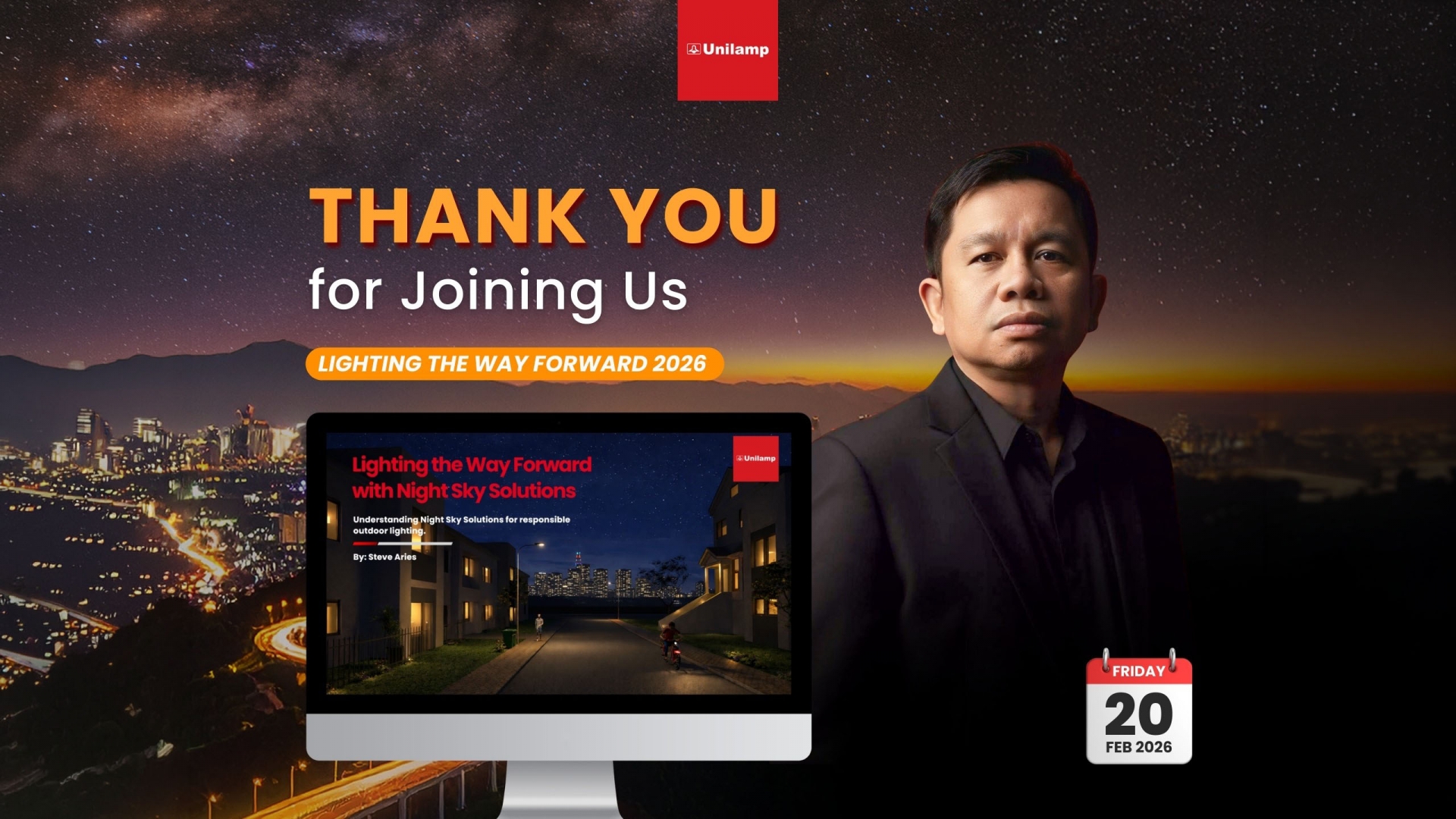
Lighting the Way Forward 2026 with Night Sky Solutions: Webinar Q&A
Unilamp’s Lighting the Way Forward 2026 with Night Sky Solutions webinar brought together lighting professionals, architects, engineers, and consultants to explore the practical application of Dark Sky compliance in modern outdoor lighting design.
The live Q&A session provided in-depth technical insights into environmental zones (E1–E4), BUG rating interpretation, façade lighting strategies, park illumination, and sustainable lighting implementation.
This article summarizes the key expert responses and guidance shared during the session, offering a comprehensive reference for professionals working on responsible outdoor lighting projects.
Do you have renderings or presentations of façade lighting projects with BUG rating analysis?
Yes. Unilamp provides façade lighting renderings and technical presentations that can include BUG rating analysis as part of Dark Sky or obtrusive lighting compliance studies. When façade lighting projects require environmental alignment, luminaires are evaluated based on their Backlight, Uplight, and Glare values to ensure compatibility with the project’s environmental zone. In most Dark Sky aligned façade designs, minimizing or eliminating uplight is a primary strategy, supported by precise optics and glare control accessories.
Which cities in Asia strictly follow Dark Sky compliance?
Dark Sky compliance in Asia is typically driven by project-specific requirements or national regulations rather than strict enforcement at the city level. While awareness of light pollution and sustainable outdoor lighting is increasing, implementation varies by country and local authority. In many urban centers, environmental classification often corresponds to E3 or E4 zones, where full compliance may depend on regulatory enforcement and coordinated planning rather than isolated projects.
What is the ideal BUG rating for luminaires used in urban or city areas?
In dense urban environments, generally classified as E3 or E4 zones, the ideal BUG rating emphasizes strict uplight control and reduced glare. While specific numerical targets depend on the environmental zone and project context, minimizing uplight (preferably U0 where feasible) and selecting luminaires with controlled glare distribution are essential. The most important factor is ensuring that the luminaire’s photometric data aligns with the environmental classification and compliance limits through proper lighting analysis.
Can one project include multiple environmental zones?
Although a project site may span areas with varying sensitivities, most compliance calculations are conducted using one environmental zone per analysis. If a site borders different classifications, separate calculations may be required. Designing to the stricter environmental zone generally ensures compliance across the broader development, simplifying the overall lighting strategy.
How is the environmental zone determined for a project site?
Environmental zones (E1–E4) are determined based on surrounding land use, brightness levels, and ecological sensitivity. E1 applies to intrinsically dark areas such as natural reserves, while E4 applies to highly urbanized city centers. Factors such as wildlife presence, residential proximity, and urban density influence zone classification. Correct identification of the zone is fundamental to successful Dark Sky compliance.
How can parks meet Dark Sky compliance while maintaining safety?
Parks can achieve Dark Sky compliance by prioritizing lighting uniformity and appropriate illumination levels rather than excessive brightness. In urban parks, maintaining moderate average lux levels with adequate vertical illuminance for CCTV visibility supports safety objectives. In rural parks, consistent uniformity may be more important than higher brightness. Incorporating dimming schedules and smart controls allows parks to reduce energy consumption while maintaining user safety.
Will Dark Sky compliance become mandatory in the future?
Dark Sky principles are increasingly integrated into sustainability frameworks worldwide. While not universally mandatory, the movement toward stricter regulation continues to grow. The environmental benefits such as reduced carbon emissions and protection of biodiversity combined with improved human health outcomes, make mandatory adoption increasingly plausible in future urban development policies.
What is a common mistake when interpreting BUG ratings?
A frequent mistake is failing to align the luminaire’s BUG rating with the project’s environmental zone. Designers may attempt to use uplighting in stricter zones where compliance limits make it impractical. Another error is selecting luminaires based on aesthetics without verifying their photometric compatibility with zone requirements. Accurate zone classification and technical evaluation are critical to avoiding non-compliant specifications.
A lake within a city that attracts migratory birds what environmental zone should it fall under?
Even if located within city limits, a lake that attracts migratory birds would typically fall under E1 due to ecological sensitivity. Wildlife habitats require stricter control of glare and uplight to prevent disruption. Environmental impact should take priority over urban classification when biodiversity is involved.
Is tree uplighting generally prohibited under Dark Sky standards?
Tree uplighting is highly restricted but not entirely prohibited. In stricter zones, very low-wattage luminaires combined with shielding and glare control may be acceptable if compliance analysis confirms that uplight and glare remain within limits. Each case must be evaluated carefully using photometric calculations to ensure environmental alignment.
What factors should be considered for façade lighting in a dense urban city area?
For high-rise buildings or façade lighting in city centers, typically classified as E3 or E4 zones, designers should prioritize downward lighting effects and limit light emission above 90 degrees. Operating schedules should also be managed to reduce unnecessary illumination during late-night hours. Even in bright urban contexts, reducing uplight and controlling glare significantly improves environmental performance while preserving architectural aesthetics.
Are there countries that provide incentives or awards for Dark Sky–compliant projects?
Yes, some European countries provide recognition programs, certifications, or incentives for Dark Sky–compliant developments. Such initiatives promote sustainable lighting practices and encourage reduced light pollution. In Asia, similar programs are less common but may expand as sustainability regulations strengthen.
What is the environmental and commercial impact of Dark Sky compliance?
Environmentally, Dark Sky compliance reduces energy consumption, lowers carbon emissions, and minimizes skyglow. By avoiding over-illumination and implementing intelligent lighting controls, projects become more sustainable. Commercially, compliant designs often reduce fixture quantities and operating costs, demonstrating that responsible outdoor lighting can be both environmentally beneficial and economically efficient.
What unique value does Unilamp offer regarding Night Sky Solutions?
Unilamp differentiates itself by providing luminaires with clearly defined BUG ratings and offering technical support for Dark Sky analysis. By assisting consultants and architects in verifying compliance through photometric evaluation and environmental zone alignment, Unilamp ensures that projects achieve both performance excellence and responsible outdoor lighting standards.
For more information about Night Sky Solutions and Dark Sky compliant outdoor lighting design, please visit: https://unilamp.co.th/en/info/night-sky-solutions
For technical consultation and project support, contact: online@unilamp.co.th
-
Project: Wanapirom Park, Thailand
-
CYCLOPS Bollard for Residential Applications
-
DarkSky Certification
-
Mini VAREE Underwater Light
-
Unilamp Welcomes CWL Lighting
-
Residential Lighting Solutions
-
Project: Ten Six Hundred, Thailand
-
ZOUK Wall Lighting for Residential Applications
-
Project: Toorak College, Australia
-
CHARISMA Bollard for Residential Lighting
-
BALIKA Visits Unilamp Factory
-
Project: SUARGA Padang Padang, Indonesia
-
ALPHA Spotlights for Residential Lighting
-
LuxBeat Lighting for Modern Residential Spaces
-
GINGGAANBAI at Baanlaesuan Fair Midyear 2026
-
BRONCO Wall Surface Light
-
Unilamp Supports Pom Mahakan Lighting
-
Low Voltage Lighting
-
ZET Architectural Inground Lighting
-
Project: Wat Tha Sung, Thailand
-
Facade Lighting Solutions
-
Webinar : Lighting the Way Forward 2026 | Facade
-
BICEPS Low-Glare Landscape Lighting
-
Premium Underwater Lighting Collection
-
Unilamp Hosts Lunch & Learn with Light.Func
-
Lighting Talk with Spatial Vibes
-
UniGreen
-
Project: The Ground Bangkok, Thailand
-
New Facade Lighting Brochure
-
Unilamp Factory Tour
-
Why Unilamp Underwater Luminaires Stand Out
-
Unilamp Welcomes Partners from Malaysia
-
Electrical Supply Corp Visits Unilamp
-
Project: Elizabeth Properties, New Zealand
-
Unilamp Webinar for New Mini CETUS
-
Mini CETUS Spotlight
-
AR+D Thesis Exhibition 2025
-
New Team Members Join Unilamp India & Middle East
-
Unilamp’s Team
-
Project Reference: Residence 15, Hyderabad, India
-
LedsC4 officially partners with Unilamp
-
Illuminates Palette of Materials Pavilion
-
Architect Expo 2026 Highlights
-
Project Reference: Central Westville, Thailand
-
Unilamp Webinar for New Mini VAREE
-
Unilamp at Architect Expo 2026
-
Micro AYERS Inground Light
-
Unilamp Joined DIALux session with PL Light
-
Unilamp Visits Nulty Lighting
-
DIALux Plugin New Update 2026
-
Polaris Lighting Visits Unilamp
-
Hiring: Senior Sales Government Projects
-
Job Opportunities
-
Quantum Implications at KU
-
Case Study: Heffron Centre, Australia
-
Joins Light + Building 2026
-
DIALux EVO Training by Unilamp at Kasetsart
-
Project Reference: Heffron Centre, Australia
-
DarkSky Compliance
-
Project Reference: City University, Hong Kong
-
New Business Development Manager at Unilamp India
-
Unilamp Supports CU Lighting Master Plan
-
The Power of Lighting Podcast - JUTI Architects
-
Q&A Night Sky Webinar 2026
-
Recap Night Sky Webinar 2026
-
THE 20 YEARS AHEAD by GingGaanBai
-
Litelab Visits Unilamp 2026
-
Lighting the Way Forward 2025 Night Sky Solutions
-
Unilamp Supports Light Arch Feb Fest 2026
-
Project: Stora Torget, Sundsvall, Sweden
-
Unilamp Supports ABAC Echoes of Memory Exhibition
-
Unilamp Lights SHMA’s Long Heal Exhibition
-
Mini ARC Outdoor Inground Light by Unilamp
-
Scholarships 2025 for Employees’ Children
-
The Power of Lighting Podcast - Zion Dzine
-
Case Study: St.Raphael Catholic Church, Thailand
-
Unilamp at Light Middle East Awards 2026
-
Project: St. Raphael Catholic Church, Thailand
-
Unilamp Appoints New SAARC Regional Manager
-
Project : National Amusement Park, Mongolia
-
Strike into Christmas with Unilamp
-
Project Reference: Shri Mata Vaishno Devi, India
-
Case Study: Bonbeach Life Saving Club, Australia
-
Case Study: Awadh Projects, India
-
HYPERION High-Performance Pole Mounted Lighting
-
The Power of Lighting Podcast – Lucent Worldwide
-
Project Reference: Avadh Utopia, Surat, India
-
University of Mindanao Visits Unilamp
-
Zion Dzine and Luxus Team Visit Unilamp
-
Project Reference: Avadh Heliconia, Vapi, India
-
Project Reference: Avadh Ayuska, Navsari, India
-
Lighting Talk with SSLD Dubai
-
Q&A Lightscapes Webinar 2025
-
Recap Lightscapes Webinar 2025
-
University of Negros Occidental-Recoletos Visits Unilamp
-
Project Reference: Residence 14, India
-
Unilamp Appoints New Regional Manager
-
Unilamp Lighting Knowledge Shared with UNO-R
-
Webinar : Lighting the Way Forward 2025 | Lightscapes
-
Unilamp Knowledge Shared with La Carlota City
-
Lucent Worldwide and Lite N Style Visit Unilamp
-
Unilamp Wraps Up Jakarta Architecture Festival 2025
-
Lighting the Way Forward in Indonesia
-
Unilamp at Baan Lae Suan Fair Living Festival 2025
-
Unilamp Joins Jakarta Architecture Festival 2025
-
Project Reference: Residence 13, India
-
Light Touch Visits Unilamp Thailand
-
Case Study Courtyard by Marriot, India
-
Infusion Lighting Visit
-
Project Reference: One Bangkok, Thailand
-
Luminaires for LED Retrofit Lamps Brochure
-
Lighting Talk with XO Lights
-
SURYA Solar Street Light
-
The Power of Lighting Podcast - Clout Edge Technologies
-
Unilamp at Baan Lae Suan Fair Mid Year 2025
-
Q&A from Webinar Lighting the Way Forward 2025
-
Webinar : Lighting the Way Forward 2025
-
Upgraded: Mini SONIC & TELESCOPE Luminaires
-
Lighting the Way Forward in Vietnam
-
Phasing Out of Products in 2025
-
Lighting Talk with Light.Func
-
Project Reference: Wan Chai, Hong Kong
-
Welcomes LITELAB & Trinity Solutions
-
Project Reference: Elio Del Nest, Thailand
-
Welcomes Clout Edge
-
Welcomes Aydinlatma Merkezi
-
Phasing Out of Products in 2024
-
Project Reference: Residence 12, Thailand
-
Project Reference: Arbour, Pattaya
-
ACQUA – No.1 in Underwater Lighting
-
Project Reference: INFORTAR Office Building, Estonia
-
UniShield16 Coating Process
-
Project Reference: Anna Ticho House, Israel
-
CYCLOPS Corten Finish
-
Project Reference: The Strand Thonglor, Thailand
-
Unilamp: Delivering Excellence
-
Project Reference: Varner HQ, Norway
-
Project Reference: Lohas Park, Hong Kong
-
Project Reference: Al Masar Park, Abu Dhabi, UAE
-
Unilamp Middle East Iftar 2025
-
Unilamp x Ginggaanbai 2025
-
Project Reference: RIU Hotel, Dubai
-
Elevating Lighting Expertise for Future Designers
-
Green Industry Certification
-
Project Reference: Bonbeach Life Saving Club, Australia
-
Unilamp Welcomes ScenoLight Atelier
-
Project Reference: Rashid Park, Abu Dhabi, UAE
-
Project Reference: Yas Bay Park, Abu Dhabi UAE
-
Unilamp Hosts FiraLux for a Special Visit
-
UniBreath
-
Unilamp’s Yacht Party 2025 Lights Up the Dubai Skyline
-
Unilamp's New Working Catalog 2025-2026
-
Project Reference: Kennedy Kakal Park, Israel
-
Bangkok Design Week 2025
-
Light Middle East Awards 2025
-
Dubai Chamber of Commerce
-
Tha-Sung Temple Walkway – Featuring EPSYLON
-
Winners of the Middle East Lighting Design Awards 2024
-
Unilamp Launches UniModification
-
Project Reference: Courtyard by Marriott Aravali Resort
-
Project Reference: GS Plaza
-
Friend of Unilamp (Testimonials)
-
Exclusive Distributors in Singapore
-
Project Reference: NGC Park of Sipalay City - Philippines
-
Project Reference: MBK Shopping Mall - Thailand
-
New product: BICEPS 4S Bollard
-
Project Reference: Gymsnasium, Estonia
-
Project reference in Oslo, Norway
-
Home and Garden Fair Midyear 2024 - Thailand
-
Unilab Testing Laboratory
-
Dialux plug-in Updated
-
Product Updated: ALESSA, NARA, NELLA, REGOR
-
Duga Sustainable City 2024 - Thailand
-
Unilamp Middle East Lighting Design Awards 2024
-
Unilamp Receives Prestigious CSR Award
-
Project Bharat Mandapam
-
New! Medium CETUS Projector
-
New! Mega BRONCO
-
DIALux Training Session for everyone...
-
Unilamp display at Light Sketch Experience Centre
-
Unilamp showcased at iDAC Mumbai 2024 at the BEPS stand
-
New! LuxBeat Underwater Linear Light
-
Celebrating 30 Years in Middle East
-
New addition! Maxi TUBE RGBW DMX
-
Project Scope Promsri
-
New! Uplight Shield Cover for CASA bollard
-
Lighting showcase at Phaya Thai Palace 101 years old
-
Unilamp joined the CNY Open House 2024
-
Unilamp sponsored for garden runway event
-
Unilamp partners with Fos Lighting Design for BKKDW2024
-
Project Marche Thonglor
-
Thanks Luxus Lighting Solutions, Slight company, Light and Beyond
-
Supported for a lighting workshop in Bangkok
-
Project Infortar Office Building
-
Thanks Stealth Ventures Corporation
-
The 7° Ultra-Narrow Beam Option
-
accessory Adjustable Aluminium Earth Spike
-
Project Botanical Garden
-
Thanks Lamar
-
PRIMUS The Innovative Pole Top Solution
-
CIC – Cite Internationale Des Chercheurs
-
Thanks Light and Shade Inc.
-
Thanks Enhance Light
-
Unilamp, a special speaker at KMUTT
-
Thanks Brilliance
-
Project Noble Curate and Noble Curve
-
Thanks Litelab
-
LuxBeat XL Ceiling Recessed, Wall Recessed
-
Project Queen Sirikit Convention Center
-
Thanks Lucent worldwide, Lite N Style from India
-
Mini PILLAR Catenary,Mini TUBE Catenary
-
Thanks Argos Arkaya Power Solutions LLP
-
Thanks Aydinlatma Merkezi
-
Tree Strap for Mini KUBIK spotlight
-
Spike for Micro ALPHA & Micro KUBIK
-
New accessory! Spike L900 for TELESCOPE
-
Thanks Directorate of civil engineering
-
Thanks Light Up Design
-
Unilamp partners with Lightcraft
-
Congratulations! Steve L. Aries
-
Thanks Studio Nimmersatt
-
THANKS District Chief Officer of Ban Sang district
-
Light Middle East | Intelligent Building
-
Project Via Riyadh, Saudi Arabia
-
Introducing Unilamp Lighting Design Centre
-
Linear Lighting Series
-
New addition! Medium ALPHA Round COB
-
Unilamp's journey in Singapore
-
Unilamp visits BioArchitek
-
Unilamp at Temca M&E Thailand 2023
-
Unilamp achieves BIS certification
-
NEW! VELA Accent light - Windowlight
-
Thanks Final Glow to visit Unilamp Showroom
-
Customized Solutions - Medium ALPHA Round ID
-
Unilamp visits DJCoalition Thailand
-
Meet Unilamp at Temca M&E Thailand 2023
-
Introducing new team member: RAVI & AFHAM
-
New! Medium SPACE RGBW
-
New! Medium CAP
-
New! NEOPLACE
-
New! BUZZ4 Ground Washer
-
Unilamp achieves SNI Certification
-
Thanks Silex to visit UNILAMP showroom
-
New product: KORNER
-
New! STICK Direct
-
Architect 2023
-
LUXBEAT
-
PRODUCT PHASE OUT LIST
-
THE UNDERWATER LUMINAIRE SERIES
-
CASA
-
Architect Expo 2022
-
NEOS
-
Mini ALPHA Square - ID
-
NEW SHARP ELLIPTICAL SERIES
-
New Product - Mini PILLAR
-
News : New colour Wooden Brown