-
More Light Doesn't Mean Better Lighting
-
Lighting Talk with Spatial Vibes
-
UniGreen
-
Project: The Ground Bangkok, Thailand
-
New Facade Lighting Brochure
-
Unilamp Factory Tour
-
Why Unilamp Underwater Luminaires Stand Out
-
Low Voltage Lighting
-
Premium Underwater Lighting Collection
-
Unilamp Welcomes Partners from Malaysia
-
Electrical Supply Corp Visits Unilamp
-
Project: Elizabeth Properties, New Zealand
-
Unilamp Webinar for New Mini CETUS
-
Mini CETUS Spotlight
-
AR+D Thesis Exhibition 2025
-
New Team Members Join Unilamp India & Middle East
-
Unilamp’s Team
-
Project Reference: Residence 15, Hyderabad, India
-
LedsC4 officially partners with Unilamp
-
Illuminates Palette of Materials Pavilion
-
Architect Expo 2026 Highlights
-
Project Reference: Central Westville, Thailand
-
Unilamp Webinar for New Mini VAREE
-
Mini VAREE Underwater Light
-
Unilamp at Architect Expo 2026
-
Micro AYERS Inground Light
-
Unilamp Joined DIALux session with PL Light
-
Unilamp Visits Nulty Lighting
-
DIALux Plugin New Update 2026
-
Polaris Lighting Visits Unilamp
-
Hiring: Senior Sales Government Projects
-
Job Opportunities
-
Quantum Implications at KU
-
Case Study: Heffron Centre, Australia
-
Joins Light + Building 2026
-
DIALux EVO Training by Unilamp at Kasetsart
-
Project Reference: Heffron Centre, Australia
-
DarkSky Compliance
-
Project Reference: City University, Hong Kong
-
New Business Development Manager at Unilamp India
-
Unilamp Supports CU Lighting Master Plan
-
The Power of Lighting Podcast - JUTI Architects
-
Q&A Night Sky Webinar 2026
-
Recap Night Sky Webinar 2026
-
THE 20 YEARS AHEAD by GingGaanBai
-
Litelab Visits Unilamp 2026
-
Lighting the Way Forward 2025 Night Sky Solutions
-
Unilamp Supports Light Arch Feb Fest 2026
-
Project: Stora Torget, Sundsvall, Sweden
-
Unilamp Supports ABAC Echoes of Memory Exhibition
-
DarkSky Certification
-
Unilamp Lights SHMA’s Long Heal Exhibition
-
Mini ARC Outdoor Inground Light by Unilamp
-
Scholarships 2025 for Employees’ Children
-
The Power of Lighting Podcast - Zion Dzine
-
Case Study: St.Raphael Catholic Church, Thailand
-
Unilamp at Light Middle East Awards 2026
-
Project: St. Raphael Catholic Church, Thailand
-
Unilamp Appoints New SAARC Regional Manager
-
Project : National Amusement Park, Mongolia
-
Strike into Christmas with Unilamp
-
Project Reference: Shri Mata Vaishno Devi, India
-
Case Study: Bonbeach Life Saving Club, Australia
-
Case Study: Awadh Projects, India
-
HYPERION High-Performance Pole Mounted Lighting
-
The Power of Lighting Podcast – Lucent Worldwide
-
Project Reference: Avadh Utopia, Surat, India
-
University of Mindanao Visits Unilamp
-
Zion Dzine and Luxus Team Visit Unilamp
-
Project Reference: Avadh Heliconia, Vapi, India
-
Project Reference: Avadh Ayuska, Navsari, India
-
Lighting Talk with SSLD Dubai
-
Q&A Lightscapes Webinar 2025
-
Recap Lightscapes Webinar 2025
-
University of Negros Occidental-Recoletos Visits Unilamp
-
Project Reference: Residence 14, India
-
Unilamp Appoints New Regional Manager
-
Unilamp Lighting Knowledge Shared with UNO-R
-
Webinar : Lighting the Way Forward 2025 | Lightscapes
-
Unilamp Knowledge Shared with La Carlota City
-
Lucent Worldwide and Lite N Style Visit Unilamp
-
Unilamp Wraps Up Jakarta Architecture Festival 2025
-
Lighting the Way Forward in Indonesia
-
Unilamp at Baan Lae Suan Fair Living Festival 2025
-
Unilamp Joins Jakarta Architecture Festival 2025
-
Project Reference: Residence 13, India
-
Light Touch Visits Unilamp Thailand
-
Case Study Courtyard by Marriot, India
-
Infusion Lighting Visit
-
Project Reference: One Bangkok, Thailand
-
Luminaires for LED Retrofit Lamps Brochure
-
Lighting Talk with XO Lights
-
SURYA Solar Street Light
-
The Power of Lighting Podcast - Clout Edge Technologies
-
Unilamp at Baan Lae Suan Fair Mid Year 2025
-
Q&A from Webinar Lighting the Way Forward 2025
-
Webinar : Lighting the Way Forward 2025
-
Upgraded: Mini SONIC & TELESCOPE Luminaires
-
Lighting the Way Forward in Vietnam
-
Phasing Out of Products in 2025
-
Lighting Talk with Light.Func
-
Project Reference: Wan Chai, Hong Kong
-
Welcomes LITELAB & Trinity Solutions
-
Project Reference: Elio Del Nest, Thailand
-
Welcomes Clout Edge
-
Welcomes Aydinlatma Merkezi
-
Phasing Out of Products in 2024
-
Project Reference: Residence 12, Thailand
-
Project Reference: Arbour, Pattaya
-
ACQUA – No.1 in Underwater Lighting
-
Project Reference: INFORTAR Office Building, Estonia
-
UniShield16 Coating Process
-
Project Reference: Anna Ticho House, Israel
-
CYCLOPS Corten Finish
-
Project Reference: The Strand Thonglor, Thailand
-
Unilamp: Delivering Excellence
-
Project Reference: Varner HQ, Norway
-
Project Reference: Lohas Park, Hong Kong
-
Project Reference: Al Masar Park, Abu Dhabi, UAE
-
Unilamp Middle East Iftar 2025
-
Unilamp x Ginggaanbai 2025
-
Project Reference: RIU Hotel, Dubai
-
Elevating Lighting Expertise for Future Designers
-
Green Industry Certification
-
Project Reference: Bonbeach Life Saving Club, Australia
-
Unilamp Welcomes ScenoLight Atelier
-
Project Reference: Rashid Park, Abu Dhabi, UAE
-
Project Reference: Yas Bay Park, Abu Dhabi UAE
-
Unilamp Hosts FiraLux for a Special Visit
-
UniBreath
-
Unilamp’s Yacht Party 2025 Lights Up the Dubai Skyline
-
Unilamp's New Working Catalog 2025-2026
-
Project Reference: Kennedy Kakal Park, Israel
-
Bangkok Design Week 2025
-
Light Middle East Awards 2025
-
Dubai Chamber of Commerce
-
Tha-Sung Temple Walkway – Featuring EPSYLON
-
Unilamp Facade Lighting Solutions
-
Winners of the Middle East Lighting Design Awards 2024
-
Unilamp Launches UniModification
-
Project Reference: Courtyard by Marriott Aravali Resort
-
Project Reference: GS Plaza
-
Friend of Unilamp (Testimonials)
-
Exclusive Distributors in Singapore
-
Project Reference: NGC Park of Sipalay City - Philippines
-
Project Reference: MBK Shopping Mall - Thailand
-
New product: BICEPS 4S Bollard
-
Project Reference: Gymsnasium, Estonia
-
Project reference in Oslo, Norway
-
Home and Garden Fair Midyear 2024 - Thailand
-
Unilab Testing Laboratory
-
Dialux plug-in Updated
-
Product Updated: ALESSA, NARA, NELLA, REGOR
-
Duga Sustainable City 2024 - Thailand
-
Unilamp Middle East Lighting Design Awards 2024
-
Unilamp Receives Prestigious CSR Award
-
Project Bharat Mandapam
-
New! Medium CETUS Projector
-
New! Mega BRONCO
-
DIALux Training Session for everyone...
-
Unilamp display at Light Sketch Experience Centre
-
Unilamp showcased at iDAC Mumbai 2024 at the BEPS stand
-
New! LuxBeat Underwater Linear Light
-
Celebrating 30 Years in Middle East
-
New addition! Maxi TUBE RGBW DMX
-
Project Scope Promsri
-
New! Uplight Shield Cover for CASA bollard
-
Lighting showcase at Phaya Thai Palace 101 years old
-
Unilamp joined the CNY Open House 2024
-
Unilamp sponsored for garden runway event
-
Unilamp partners with Fos Lighting Design for BKKDW2024
-
Project Marche Thonglor
-
Thanks Luxus Lighting Solutions, Slight company, Light and Beyond
-
Supported for a lighting workshop in Bangkok
-
Project Infortar Office Building
-
Thanks Stealth Ventures Corporation
-
The 7° Ultra-Narrow Beam Option
-
accessory Adjustable Aluminium Earth Spike
-
Project Botanical Garden
-
Thanks Lamar
-
PRIMUS The Innovative Pole Top Solution
-
CIC – Cite Internationale Des Chercheurs
-
Thanks Light and Shade Inc.
-
Thanks Enhance Light
-
Unilamp, a special speaker at KMUTT
-
Thanks Brilliance
-
Project Noble Curate and Noble Curve
-
Thanks Litelab
-
LuxBeat XL Ceiling Recessed, Wall Recessed
-
Project Queen Sirikit Convention Center
-
Thanks Lucent worldwide, Lite N Style from India
-
Mini PILLAR Catenary,Mini TUBE Catenary
-
Thanks Argos Arkaya Power Solutions LLP
-
Thanks Aydinlatma Merkezi
-
Tree Strap for Mini KUBIK spotlight
-
Spike for Micro ALPHA & Micro KUBIK
-
New accessory! Spike L900 for TELESCOPE
-
Thanks Directorate of civil engineering
-
Thanks Light Up Design
-
Unilamp partners with Lightcraft
-
Congratulations! Steve L. Aries
-
Thanks Studio Nimmersatt
-
THANKS District Chief Officer of Ban Sang district
-
Light Middle East | Intelligent Building
-
Project Via Riyadh, Saudi Arabia
-
Introducing Unilamp Lighting Design Centre
-
Linear Lighting Series
-
New addition! Medium ALPHA Round COB
-
Unilamp's journey in Singapore
-
Unilamp visits BioArchitek
-
Unilamp at Temca M&E Thailand 2023
-
Unilamp achieves BIS certification
-
NEW! VELA Accent light - Windowlight
-
Thanks Final Glow to visit Unilamp Showroom
-
Customized Solutions - Medium ALPHA Round ID
-
Unilamp visits DJCoalition Thailand
-
Meet Unilamp at Temca M&E Thailand 2023
-
Introducing new team member: RAVI & AFHAM
-
New! Medium SPACE RGBW
-
New! Medium CAP
-
New! NEOPLACE
-
New! BUZZ4 Ground Washer
-
Unilamp achieves SNI Certification
-
Thanks Silex to visit UNILAMP showroom
-
New product: KORNER
-
New! STICK Direct
-
Architect 2023
-
LUXBEAT
-
PRODUCT PHASE OUT LIST
-
THE UNDERWATER LUMINAIRE SERIES
-
CASA
-
Architect Expo 2022
-
NEOS
-
Mini ALPHA Square - ID
-
NEW SHARP ELLIPTICAL SERIES
-
New Product - Mini PILLAR
-
News : New colour Wooden Brown
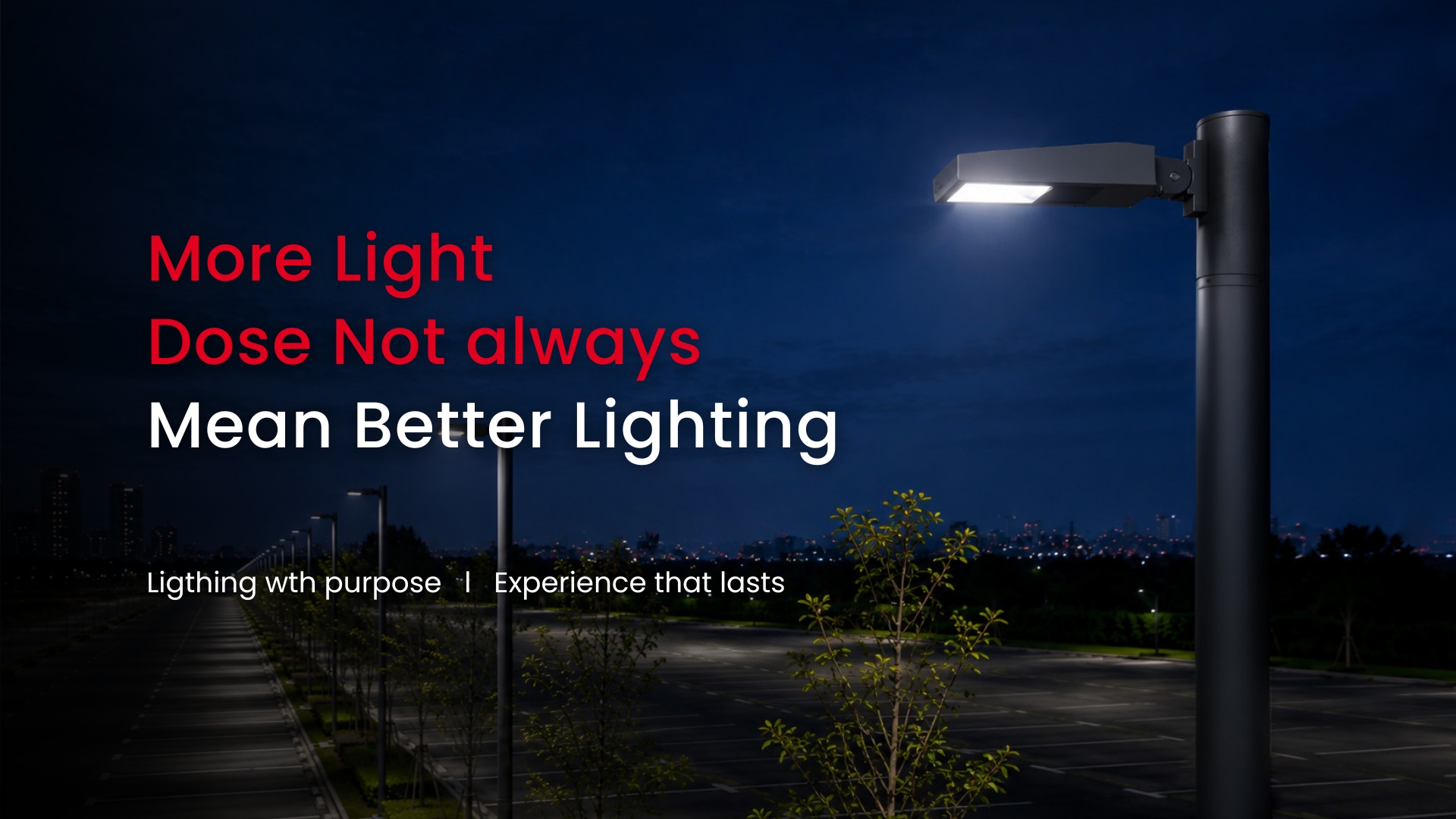
More Light Does Not Always Mean Better Lighting
In architectural outdoor lighting, successful projects are not defined by the amount of light used. They are defined by how effectively light contributes to the experience of a space.
Working alongside architects, landscape architects, lighting designers, and consultants across a wide range of architectural outdoor projects, Unilamp has learned that exceptional lighting is rarely about adding more light. It is about placing light with purpose.
Whether illuminating a landscape, enhancing a facade, creating a welcoming residential environment, or bringing a water feature to life, the objective is not simply to increase brightness. The objective is to reveal architecture, guide movement, create atmosphere, and support visual comfort.
As lighting technology continues to evolve, designers now have access to luminaires with increasingly sophisticated optical systems, allowing projects to achieve outstanding visual results with greater efficiency than ever before.
Lighting with Purpose
Every lighting project begins with design intent.
Some elements are intended to become focal points, while others provide visual balance and support. Architecture, landscape, circulation routes, and gathering spaces each contribute to the overall nighttime experience.
Thoughtful lighting design creates hierarchy, helping people intuitively understand and navigate a space. It directs attention, reinforces architectural character, and shapes the atmosphere after dark.
This approach often places greater value on optical precision, light distribution, and visual comfort than on brightness alone.
The Evolution of Performance
Advances in optical engineering have transformed the way designers approach outdoor lighting.
Today, high-performance luminaires can distribute light more effectively, enabling designers to achieve both visual quality and operational efficiency.
This creates opportunities to:
- Optimize luminaire placement
- Reduce infrastructure requirements
- Improve energy efficiency
- Enhance visual comfort
- Maintain a clean architectural and landscape aesthetic
Rather than focusing solely on the number of luminaires within a project, designers can evaluate how effectively each luminaire contributes to the overall lighting objective.
NEOS: Pole Mounted Light
A practical example of this principle can be found in NEOS
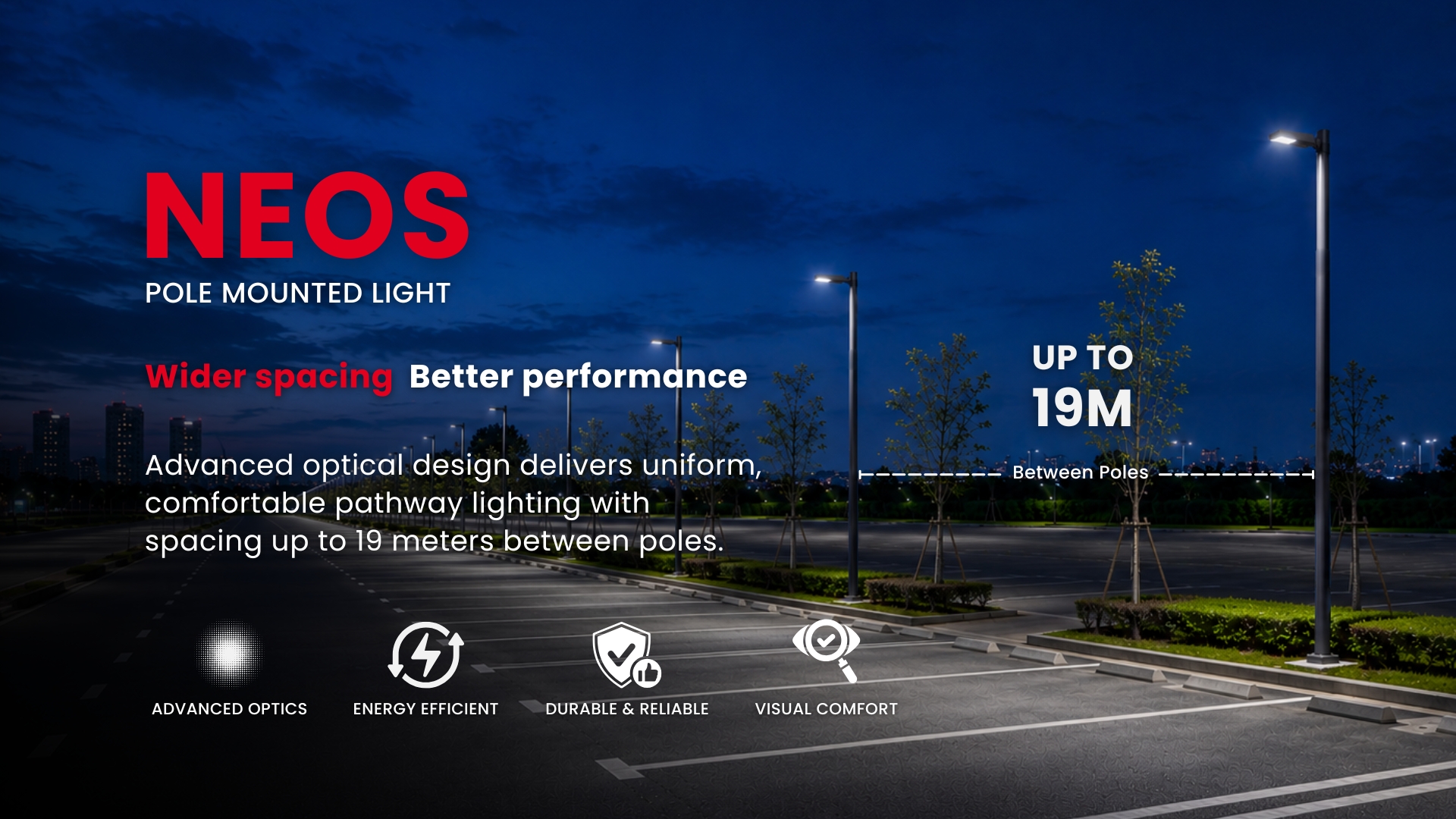
Developed with advanced optical performance in mind, NEOS is designed to achieve wider spacing between luminaires while maintaining functional pathway illumination and visual comfort.
Under suitable project conditions, NEOS can achieve spacing of up to 19 meters between pole mounted light. This wider spacing capability allows designers to illuminate longer pathways with fewer luminaires while maintaining a balanced and comfortable nighttime environment.
Benefits of Optimized Spacing
- Wider luminaire coverage
- Reduced infrastructure and cabling requirements
- Lower energy consumption
- Simplified maintenance planning
- Cleaner landscape integration
- Greater project efficiency
For hospitality developments, residential communities, educational campuses, parks, and public spaces, optimized spacing can contribute to both project performance and long-term value.
The design conversation therefore evolves from:
"How many luminaires are required?"
to
"How effectively can each luminaire perform?"
This is where optical design becomes an important part of creating successful outdoor environments.
Designing for Experience
Lighting performance is influenced by multiple factors working together, including:
- Optical distribution
- Beam control
- Luminaire positioning
- Contrast and hierarchy
- Visual comfort
- Architectural integration
When these elements are carefully balanced, the result is a nighttime environment that feels comfortable, engaging, and visually refined.
In many projects, the most memorable experiences are created not through higher light levels, but through thoughtful lighting design that supports the architecture and landscape while respecting the character of the space.
The Unilamp Approach
At Unilamp, we believe architectural outdoor lighting should combine performance, efficiency, and design intent.
Through Unilamp R&D, our luminaires are developed to address real project challenges from wider spacing and optical precision to durability, reliability, and visual comfort.
NEOS demonstrates how thoughtful optical engineering can help designers achieve more with each luminaire, supporting efficient and elegant lighting solutions without compromising the user experience.
Because in architectural outdoor lighting, success is not measured by how much light is added to a space, but by how effectively light enhances the experience of that space.
For technical consultation, project-specific guidance, or UniModification inquiries, please contact the Unilamp team at online@unilamp.co.th.
-
More Light Doesn't Mean Better Lighting
-
Lighting Talk with Spatial Vibes
-
UniGreen
-
Project: The Ground Bangkok, Thailand
-
New Facade Lighting Brochure
-
Unilamp Factory Tour
-
Why Unilamp Underwater Luminaires Stand Out
-
Low Voltage Lighting
-
Premium Underwater Lighting Collection
-
Unilamp Welcomes Partners from Malaysia
-
Electrical Supply Corp Visits Unilamp
-
Project: Elizabeth Properties, New Zealand
-
Unilamp Webinar for New Mini CETUS
-
Mini CETUS Spotlight
-
AR+D Thesis Exhibition 2025
-
New Team Members Join Unilamp India & Middle East
-
Unilamp’s Team
-
Project Reference: Residence 15, Hyderabad, India
-
LedsC4 officially partners with Unilamp
-
Illuminates Palette of Materials Pavilion
-
Architect Expo 2026 Highlights
-
Project Reference: Central Westville, Thailand
-
Unilamp Webinar for New Mini VAREE
-
Mini VAREE Underwater Light
-
Unilamp at Architect Expo 2026
-
Micro AYERS Inground Light
-
Unilamp Joined DIALux session with PL Light
-
Unilamp Visits Nulty Lighting
-
DIALux Plugin New Update 2026
-
Polaris Lighting Visits Unilamp
-
Hiring: Senior Sales Government Projects
-
Job Opportunities
-
Quantum Implications at KU
-
Case Study: Heffron Centre, Australia
-
Joins Light + Building 2026
-
DIALux EVO Training by Unilamp at Kasetsart
-
Project Reference: Heffron Centre, Australia
-
DarkSky Compliance
-
Project Reference: City University, Hong Kong
-
New Business Development Manager at Unilamp India
-
Unilamp Supports CU Lighting Master Plan
-
The Power of Lighting Podcast - JUTI Architects
-
Q&A Night Sky Webinar 2026
-
Recap Night Sky Webinar 2026
-
THE 20 YEARS AHEAD by GingGaanBai
-
Litelab Visits Unilamp 2026
-
Lighting the Way Forward 2025 Night Sky Solutions
-
Unilamp Supports Light Arch Feb Fest 2026
-
Project: Stora Torget, Sundsvall, Sweden
-
Unilamp Supports ABAC Echoes of Memory Exhibition
-
DarkSky Certification
-
Unilamp Lights SHMA’s Long Heal Exhibition
-
Mini ARC Outdoor Inground Light by Unilamp
-
Scholarships 2025 for Employees’ Children
-
The Power of Lighting Podcast - Zion Dzine
-
Case Study: St.Raphael Catholic Church, Thailand
-
Unilamp at Light Middle East Awards 2026
-
Project: St. Raphael Catholic Church, Thailand
-
Unilamp Appoints New SAARC Regional Manager
-
Project : National Amusement Park, Mongolia
-
Strike into Christmas with Unilamp
-
Project Reference: Shri Mata Vaishno Devi, India
-
Case Study: Bonbeach Life Saving Club, Australia
-
Case Study: Awadh Projects, India
-
HYPERION High-Performance Pole Mounted Lighting
-
The Power of Lighting Podcast – Lucent Worldwide
-
Project Reference: Avadh Utopia, Surat, India
-
University of Mindanao Visits Unilamp
-
Zion Dzine and Luxus Team Visit Unilamp
-
Project Reference: Avadh Heliconia, Vapi, India
-
Project Reference: Avadh Ayuska, Navsari, India
-
Lighting Talk with SSLD Dubai
-
Q&A Lightscapes Webinar 2025
-
Recap Lightscapes Webinar 2025
-
University of Negros Occidental-Recoletos Visits Unilamp
-
Project Reference: Residence 14, India
-
Unilamp Appoints New Regional Manager
-
Unilamp Lighting Knowledge Shared with UNO-R
-
Webinar : Lighting the Way Forward 2025 | Lightscapes
-
Unilamp Knowledge Shared with La Carlota City
-
Lucent Worldwide and Lite N Style Visit Unilamp
-
Unilamp Wraps Up Jakarta Architecture Festival 2025
-
Lighting the Way Forward in Indonesia
-
Unilamp at Baan Lae Suan Fair Living Festival 2025
-
Unilamp Joins Jakarta Architecture Festival 2025
-
Project Reference: Residence 13, India
-
Light Touch Visits Unilamp Thailand
-
Case Study Courtyard by Marriot, India
-
Infusion Lighting Visit
-
Project Reference: One Bangkok, Thailand
-
Luminaires for LED Retrofit Lamps Brochure
-
Lighting Talk with XO Lights
-
SURYA Solar Street Light
-
The Power of Lighting Podcast - Clout Edge Technologies
-
Unilamp at Baan Lae Suan Fair Mid Year 2025
-
Q&A from Webinar Lighting the Way Forward 2025
-
Webinar : Lighting the Way Forward 2025
-
Upgraded: Mini SONIC & TELESCOPE Luminaires
-
Lighting the Way Forward in Vietnam
-
Phasing Out of Products in 2025
-
Lighting Talk with Light.Func
-
Project Reference: Wan Chai, Hong Kong
-
Welcomes LITELAB & Trinity Solutions
-
Project Reference: Elio Del Nest, Thailand
-
Welcomes Clout Edge
-
Welcomes Aydinlatma Merkezi
-
Phasing Out of Products in 2024
-
Project Reference: Residence 12, Thailand
-
Project Reference: Arbour, Pattaya
-
ACQUA – No.1 in Underwater Lighting
-
Project Reference: INFORTAR Office Building, Estonia
-
UniShield16 Coating Process
-
Project Reference: Anna Ticho House, Israel
-
CYCLOPS Corten Finish
-
Project Reference: The Strand Thonglor, Thailand
-
Unilamp: Delivering Excellence
-
Project Reference: Varner HQ, Norway
-
Project Reference: Lohas Park, Hong Kong
-
Project Reference: Al Masar Park, Abu Dhabi, UAE
-
Unilamp Middle East Iftar 2025
-
Unilamp x Ginggaanbai 2025
-
Project Reference: RIU Hotel, Dubai
-
Elevating Lighting Expertise for Future Designers
-
Green Industry Certification
-
Project Reference: Bonbeach Life Saving Club, Australia
-
Unilamp Welcomes ScenoLight Atelier
-
Project Reference: Rashid Park, Abu Dhabi, UAE
-
Project Reference: Yas Bay Park, Abu Dhabi UAE
-
Unilamp Hosts FiraLux for a Special Visit
-
UniBreath
-
Unilamp’s Yacht Party 2025 Lights Up the Dubai Skyline
-
Unilamp's New Working Catalog 2025-2026
-
Project Reference: Kennedy Kakal Park, Israel
-
Bangkok Design Week 2025
-
Light Middle East Awards 2025
-
Dubai Chamber of Commerce
-
Tha-Sung Temple Walkway – Featuring EPSYLON
-
Unilamp Facade Lighting Solutions
-
Winners of the Middle East Lighting Design Awards 2024
-
Unilamp Launches UniModification
-
Project Reference: Courtyard by Marriott Aravali Resort
-
Project Reference: GS Plaza
-
Friend of Unilamp (Testimonials)
-
Exclusive Distributors in Singapore
-
Project Reference: NGC Park of Sipalay City - Philippines
-
Project Reference: MBK Shopping Mall - Thailand
-
New product: BICEPS 4S Bollard
-
Project Reference: Gymsnasium, Estonia
-
Project reference in Oslo, Norway
-
Home and Garden Fair Midyear 2024 - Thailand
-
Unilab Testing Laboratory
-
Dialux plug-in Updated
-
Product Updated: ALESSA, NARA, NELLA, REGOR
-
Duga Sustainable City 2024 - Thailand
-
Unilamp Middle East Lighting Design Awards 2024
-
Unilamp Receives Prestigious CSR Award
-
Project Bharat Mandapam
-
New! Medium CETUS Projector
-
New! Mega BRONCO
-
DIALux Training Session for everyone...
-
Unilamp display at Light Sketch Experience Centre
-
Unilamp showcased at iDAC Mumbai 2024 at the BEPS stand
-
New! LuxBeat Underwater Linear Light
-
Celebrating 30 Years in Middle East
-
New addition! Maxi TUBE RGBW DMX
-
Project Scope Promsri
-
New! Uplight Shield Cover for CASA bollard
-
Lighting showcase at Phaya Thai Palace 101 years old
-
Unilamp joined the CNY Open House 2024
-
Unilamp sponsored for garden runway event
-
Unilamp partners with Fos Lighting Design for BKKDW2024
-
Project Marche Thonglor
-
Thanks Luxus Lighting Solutions, Slight company, Light and Beyond
-
Supported for a lighting workshop in Bangkok
-
Project Infortar Office Building
-
Thanks Stealth Ventures Corporation
-
The 7° Ultra-Narrow Beam Option
-
accessory Adjustable Aluminium Earth Spike
-
Project Botanical Garden
-
Thanks Lamar
-
PRIMUS The Innovative Pole Top Solution
-
CIC – Cite Internationale Des Chercheurs
-
Thanks Light and Shade Inc.
-
Thanks Enhance Light
-
Unilamp, a special speaker at KMUTT
-
Thanks Brilliance
-
Project Noble Curate and Noble Curve
-
Thanks Litelab
-
LuxBeat XL Ceiling Recessed, Wall Recessed
-
Project Queen Sirikit Convention Center
-
Thanks Lucent worldwide, Lite N Style from India
-
Mini PILLAR Catenary,Mini TUBE Catenary
-
Thanks Argos Arkaya Power Solutions LLP
-
Thanks Aydinlatma Merkezi
-
Tree Strap for Mini KUBIK spotlight
-
Spike for Micro ALPHA & Micro KUBIK
-
New accessory! Spike L900 for TELESCOPE
-
Thanks Directorate of civil engineering
-
Thanks Light Up Design
-
Unilamp partners with Lightcraft
-
Congratulations! Steve L. Aries
-
Thanks Studio Nimmersatt
-
THANKS District Chief Officer of Ban Sang district
-
Light Middle East | Intelligent Building
-
Project Via Riyadh, Saudi Arabia
-
Introducing Unilamp Lighting Design Centre
-
Linear Lighting Series
-
New addition! Medium ALPHA Round COB
-
Unilamp's journey in Singapore
-
Unilamp visits BioArchitek
-
Unilamp at Temca M&E Thailand 2023
-
Unilamp achieves BIS certification
-
NEW! VELA Accent light - Windowlight
-
Thanks Final Glow to visit Unilamp Showroom
-
Customized Solutions - Medium ALPHA Round ID
-
Unilamp visits DJCoalition Thailand
-
Meet Unilamp at Temca M&E Thailand 2023
-
Introducing new team member: RAVI & AFHAM
-
New! Medium SPACE RGBW
-
New! Medium CAP
-
New! NEOPLACE
-
New! BUZZ4 Ground Washer
-
Unilamp achieves SNI Certification
-
Thanks Silex to visit UNILAMP showroom
-
New product: KORNER
-
New! STICK Direct
-
Architect 2023
-
LUXBEAT
-
PRODUCT PHASE OUT LIST
-
THE UNDERWATER LUMINAIRE SERIES
-
CASA
-
Architect Expo 2022
-
NEOS
-
Mini ALPHA Square - ID
-
NEW SHARP ELLIPTICAL SERIES
-
New Product - Mini PILLAR
-
News : New colour Wooden Brown