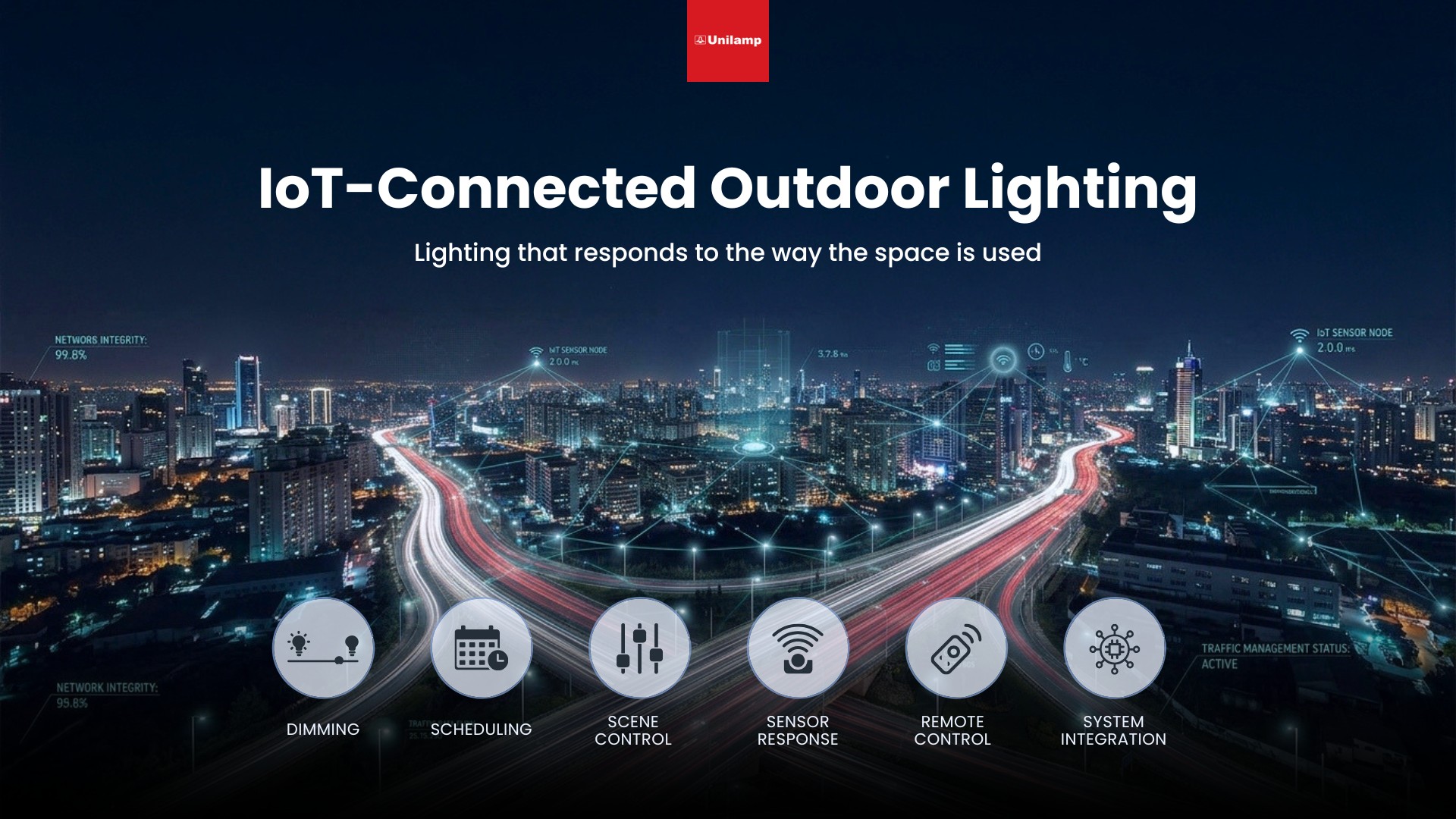
IoT-Connected Outdoor Lighting
Choose the Control Strategy Around the Space
Connected lighting is not only about adding more technology. For outdoor lighting projects, the more useful question is:
How should the lighting respond to the way the space is used?
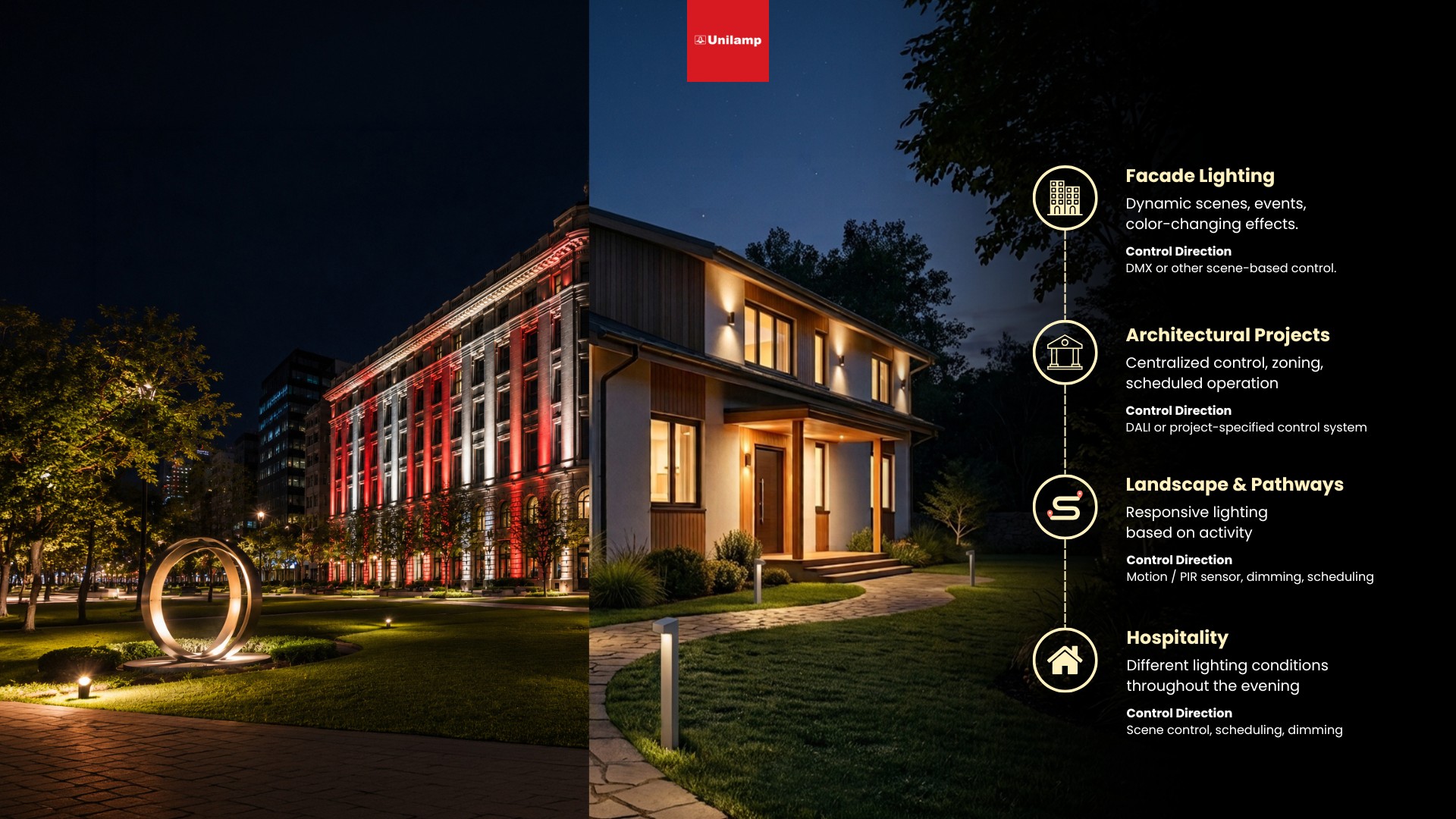
A facade may need dynamic scenes. A hospitality project may require different lighting conditions throughout the evening. A pathway may benefit from sensor-based operation, while a larger architectural project may need centralized control.
The right control strategy depends on the application, operating pattern, and project infrastructure.
Which Control Approach Fits the Project?
|
Application |
Typical Requirement |
Control Direction to Consider |
|
Facade Lighting |
Dynamic scenes, events, color-changing effects |
DMX or other scene-based control |
|
Architectural Projects |
Centralized control, zoning, scheduled operation |
DALI or project-specified control system |
|
Landscape & Pathways |
Responsive lighting based on activity |
Motion / PIR sensor, dimming, scheduling |
|
Hospitality |
Different lighting conditions throughout the evening |
Scene control, scheduling, dimming |
These are not fixed rules. The final control method should always be selected according to the project requirements, luminaire configuration, and overall system design.
Start with the Project Requirement
Before selecting the control system, define the project requirements step by step.
Step 1 — Application
What needs to be illuminated?
Define the type of space, the visual objective, and how people will use the area after dark.
Step 2 — Lighting
What lighting effect and optical performance are required?
Consider light distribution, positioning, aiming, visual comfort, and the relationship between the luminaire and the architecture or landscape.
Step 3 — Control
How should the lighting operate throughout the night?
Determine whether the project requires dimming, scheduling, scenes, sensors, or another control function.
Step 4 — Integration
How should the luminaire work with the project infrastructure?
Confirm the required control system, communication method, driver compatibility, and any wider system integration.
Considering these requirements in sequence helps project teams align the luminaire, control strategy, and system architecture from the beginning.
It also helps avoid selecting a luminaire first and discovering later that the required control configuration is not available.
Consider Control Early
Control decisions can affect:
- Driver selection
- Dimming compatibility
- Sensor integration
- Wiring and communication
- Zoning strategy
- Centralized control requirements
- Future system expansion
For this reason, control requirements should ideally be considered during luminaire selection, not after the lighting design is complete.
When Standard Is Not Enough
A project requirement does not always match a standard luminaire configuration.
This is where Unimodification can add value.
For connected lighting and control applications, Unilamp can evaluate modification possibilities including:
|
Control |
Wireless |
Sensor |
|
DALI |
Zigbee |
Motion Sensor |
|
DMX |
Bluetooth |
PIR Sensor |
|
0–10V |
Wi-Fi |
|
|
1–10V |
Depending on the project, Unimodification can also evaluate other luminaire requirements such as optics, CCT, finishes, mounting, and electrical configuration.
Each modification should be reviewed according to technical feasibility and the requirements of the application.
Learn more about Unimodification

Make the Luminaire Fit the Project
Instead of asking:
“What control options does this standard luminaire already have?”
A better question is:
“What does the project need the luminaire to do?”
Through Unimodification, Unilamp can review project-specific control requirements and explore how the luminaire may be configured to support the intended lighting and operational strategy.
Have a Specific Control Requirement?
Whether your project requires DALI, DMX, wireless control, sensor integration, or another project-specific configuration, the Unilamp team can help review the requirement and explore an appropriate Unimodification solution. Contact Unilamp
online@unilamp.co.th