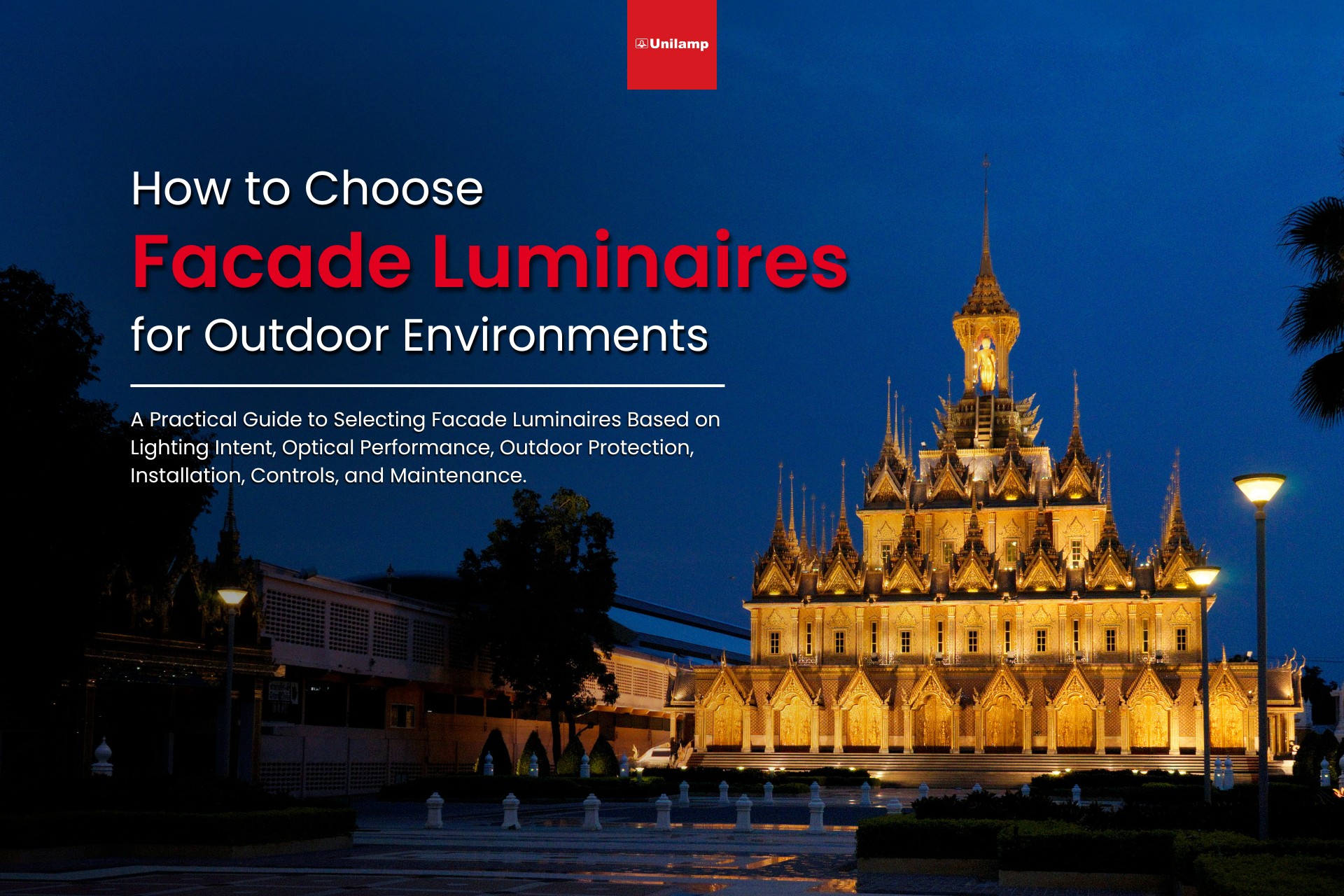
How to Choose Facade Luminaires for Outdoor Environments
Unilamp develops premium architectural facade lighting solutions engineered for demanding outdoor environments. Trusted by lighting designers, architects, consultants, and developers across Asia and beyond, our luminaires are designed to balance architectural creativity with long-term outdoor performance.
Selecting the right facade luminaire involves more than choosing sufficient lumen output. It requires balancing architectural intent, optical precision, environmental protection, installation requirements, maintenance accessibility, and control compatibility to meet the specific needs of each project.
Whether illuminating a commercial tower, hospitality development, public space, landmark, or luxury residence, considering the complete lighting system during the design stage helps improve visual quality, simplify maintenance, and support reliable long-term performance.
Step 1 – Define the Lighting Objective
Every facade lighting project begins by defining how the architecture should be experienced after dark. The intended lighting effect influences the choice of luminaire, optics, mounting position, and control strategy.
Different lighting techniques create different architectural expressions.
|
Lighting Technique |
Primary Purpose |
Typical Application |
|
Wall Washing |
Uniform illumination |
Large building facades |
|
Wall Grazing |
Reveal texture |
Stone, brick and textured concrete |
|
Accent Lighting |
Highlight architectural details |
Columns, sculptures and entrances |
|
Linear Highlighting |
Define architectural lines |
Roof edges, fins and building outlines |
Before selecting a luminaire, consider:
- Which architectural element should become the visual focus?
- From where will the building be viewed?
- Is uniform illumination or strong contrast preferred?
- Should the lighting become a subtle architectural enhancement or a dominant visual feature?
The lighting objective should always determine the luminaire selection.
Step 2 – Select the Appropriate Optics
Optics determine how efficiently light reaches the architectural surface.
A higher lumen output does not necessarily create a better lighting result. Carefully controlled optical distributions often improve visual comfort, minimise spill light, and deliver greater lighting precision.
Evaluate:
- Beam angle
- Mounting distance
- Luminaire spacing
- Facade height
- Surface reflectance
- Aiming angle
- Ambient lighting conditions
Lighting calculations should verify:
- Target illuminance
- Uniformity
- Contrast
- Beam overlap
- Spill light
- Glare from key viewing positions
Step 3 – Choose the Appropriate Light Quality
Light quality significantly influences how architectural materials appear at night.
Warm white lighting generally complements brick, timber, bronze, and natural stone, while neutral or cooler colour temperatures often suit concrete, metal, and contemporary glass architecture.
Designers should evaluate:
- Colour temperature (CCT)
- Colour rendering (CRI)
- Colour consistency
- Surface reflectance
- Brightness contrast
- Overall architectural character
For dynamic facade lighting, verify compatibility between luminaires, drivers, controllers, and the selected control system before specification.
Step 4 – Evaluate the Outdoor Environment
Outdoor luminaires operate under conditions that extend well beyond laboratory testing.
Although IP and IK ratings are important performance indicators, they should be considered together with the actual installation environment.
Review:
- Installation orientation
- Water drainage
- Cable entry protection
- Ambient temperature
- Direct sunlight
- Irrigation exposure
- Dust and airborne pollution
- Mechanical impact
Temperature fluctuations may also create pressure changes inside the luminaire enclosure. Effective thermal management, pressure equalisation, moisture control, and drainage all contribute to reliable long-term performance.
Step 5 – Select Materials for Long-Term Durability
Outdoor durability depends on the complete luminaire construction rather than the housing material alone.
Consider:
- Surface pretreatment
- Protective coating systems
- Housing materials
- Glass quality
- Gaskets
- Fasteners
- Contact between dissimilar metals
Projects located in coastal, marine, and industrial environments require enhanced corrosion protection due to salt, humidity, and airborne contaminants.
Material selection should always reflect the environmental exposure of the project.
Step 6 – Review Visual Comfort, Controls and Electrical Requirements
Effective facade lighting enhances architecture while maintaining visual comfort for pedestrians, occupants, and surrounding environments.
Good practice includes:
- Controlled optical distributions
- Appropriate aiming
- Glare-control accessories
- Suitable setback distances
- Dimming where appropriate
Electrical coordination should also review:
- Driver accessibility
- Surge protection
- Earthing
- Cable routing
- Connector compatibility
- Dimming protocol
- Control system integration
Considering these requirements early helps simplify installation and future maintenance.
Step 7 – Plan for Installation and Maintenance
Installation quality directly affects lighting performance throughout the life of the project.
Designers should provide access for:
- Cleaning optical surfaces
- Driver replacement
- Optical adjustment
- Seal inspection
- Cable maintenance
- Drainage cleaning
Maintenance should be considered as part of the design process, not after project completion.
Common Specification Mistakes
Many facade lighting challenges originate during specification rather than installation.
Avoid:
- Selecting luminaires based solely on lumen output
- Ignoring optical distribution
- Relying only on IP ratings
- Overlooking drainage requirements
- Ignoring pedestrian viewing angles
- Failing to plan maintenance access
- Selecting incompatible control systems
Careful specification often has a greater impact on lighting performance than increasing luminaire output.
Facade Luminaire Selection Checklist
- Before final specification, verify:
- Lighting objective
- Lighting technique
- Optical distribution
- Mounting location
- Photometric calculations
- Visual comfort
- Environmental suitability
- Drainage
- Maintenance access
- Control compatibility
- Electrical protection
- Long-term serviceability
Unilamp Facade Lighting Solutions
Unilamp offers a comprehensive portfolio of premium architectural luminaires for facade lighting applications.
|
Lighting Application |
Unilamp Solution |
|
Linear facade highlighting |
LuxBeat |
|
Architectural spotlighting |
ALPHA |
|
High-output facade illumination |
SPACE |
|
Wall-mounted illumination |
AGAR |
|
Decorative up/down lighting |
BRONCO |
|
Surface-mounted uplighting |
SHOOTER |
|
Adjustable inground lighting |
ARC |
|
Shallow inground applications |
QUARK |
The appropriate luminaire should always be selected according to the project's lighting objective, optical requirements, environmental conditions, installation constraints, and maintenance strategy.
Explore More about Facade Lighting Solutions
Discover the complete range of Unilamp facade luminaires, lighting techniques, technical features, and application possibilities.
Link : https://unilamp.co.th/en/info/facade-lighting-solutions
The Unilamp Approach
At Unilamp, we engineer premium architectural lighting solutions that combine precise optical control, application flexibility, and advanced outdoor durability. Technologies such as Unishield, Unibreath, and Uniblock (available on selected products) are developed to enhance corrosion resistance, pressure equalization, and moisture management, supporting reliable performance in demanding outdoor environments.
Backed by decades of expertise in architectural and landscape lighting, Unilamp partners with lighting designers, architects, consultants, and developers to deliver lighting solutions that combine design excellence, engineering precision, and long-term reliability.
For technical consultation, photometric support, or project-specific guidance, please contact online@unilamp.co.th